This is the second in a series of posts about Zion National Park
Zion Canyon is a canyon through which the Virgin River – a tributary of the Colorado River – runs. All of what I explored during my trip to Zion National Park was in Zion Canyon, only a small fraction of the park itself.
In April, Zion Canyon Scenic Drive – the road through Zion Canyon – is only open to the park shuttle which runs from the Visitor Center (stop 1) in the South to the Temple of Sinawava (stop 9) in the North. Stop number 4 is called the Court of the Patriarchs, after a grouping of rock towers named the Three Patriarchs (after the biblical Abraham, Isaac, and Jacob).
Three Patriarchs (Abraham to the left, Isaac in the center, and Jacob on the right in the background) and Mount Moroni (right foreground).
The Three Patriarchs are composed of a rock unit called the Navajo Sandstone. If you recall the first post in this series – about Checkerboard Mesa – you’ll have heard of Navajo Sandstone. Navajo Sandstone is at least about 200 million years old but may be slightly older and was deposited over a period of about 5.5 million years. It is a sandstone (sedimentary rock) and it is the thickest stratigraphic unit in Zion National Park. The major rock layers are represented by a stratigraphic colum shown below.
Stratigraphic column depicting rock layers that make up formations in Zion National Park. The layers are stacked in order of deposition with the uppermost layers being the youngest (deposited last) and the lowermost layers being the oldest (deposited first). Also depicted are the types of fossils and sedimentary structures that can be found in the units. The diagonal lines in the Navajo Sandstone represent cross-beds. For more information on the Navajo Sandstone and other units see this NPS page from which this column was copied.
As mentioned in the above caption, the Navajo Sandstone is known for its prominent large-scale cross-bedding. So what is cross-bedding exactly? Well, it’s a sedimentary structure (feature of a sedimentary rock) that forms when layers develop at an angle with the primary bedding plane. An example of this in the Navajo Sandstone is given in the picture I took while hiking Angel’s Landing Trail in Zion National Park.
An example of cross-bedding in the Navajo Sandstone along the Angel’s Landing trail. The horizontal lines are the bedding planes and the diagonal lines are the cross-beds. The cross-beds result from sand dunes deposited and shaped by wind flowing right to left in this case.
The Navajo Sandstone represents a remnant of an ancient field of sand dunes in a desert that existed during the early Jurassic – about 200 million years ago. This vast desert landscape extended across the Colorado Plateau region and beyond, approximately spanning from eastern CA to central NM and from Idaho to the Mexico border. This was the largest known sand desert in the history of our planet!
Cross-beds from sand dunes are significant because they tell us about the depositional environment; namely, the direction of transport for the sand grains that eventually formed the rock. For more about this see the diagram below.
A diagram depicting the formation of sand dunes and associated cross-beds. The cross-beds point downward in the direction of wind travel (left to right in this case). Credit: NPS
Stay tuned for more on Zion National Park and its geologic wonders!
This post is a little different in that it is about mental health so I just want to make it clear that I’m not a mental health professional and everything here is either something I learned from a mental health expert or is based on my personal experiences.
If you feel like your mental wellness could use some work, you might start with a mental health hotline or visit to your student health clinic or campus counseling center.
I’m a graduate student living in 2022 so naturally I suffer from a few mental health disorders. Not that we all do, but research suggests I’m not alone. Also, sadly, it’s not something that many programs or supervisors address effectively.
So what is one to do? That’s a hard question: one I’ve been trying to navigate for years but I’ve been taking a few steps focused on improving my mental health recently and I’ve made a lot of progress in the last few years so I thought I might share some of my experiences in case others can benefit. Now, I’ve had a lot of support: family, friends, colleagues, mentors, and of course – professionals. The roles of these people can’t be overstated; however, there are some things that I’ve had to figure out independently – the first of which was how to utilize resources available to me. So if you feel like your mental wellness could use some work, you might start with a mental health hotline or visit to your student health clinic or campus counseling center.
Through my mental wellness journey, one of the tools I picked up along the way comes from a type of therapy known as CBT or cognitive behavioral therapy. It’s called behavioral activation and it has to do with the way actions impact emotions, or in CBT-speak: how behaviors impact feelings.
See, I was having this problem – brought on by my clinical depression – where I couldn’t find the motivation to do the things I enjoyed, which included both recreational activities and work activities.
I told my therapist about this and we tried a few things but the one that really worked for me in the end was behavioral activation. So here I’ll describe what it is and how to use it.
I’ve often equated behavioral activation as a clinical term for the adage: “fake it ’til you make it” but that doesn’t really capture the entirety of the concept. There are many layers this tool which are outlined in a way that makes sense to me below. But, if you’re interested in the TL;DR version: behavioral activation is simply the practice of initiating a task prior to achieving the motivation to doit. Essentially, you start doing the thing and the motivation follows.
Here’s how I see it:
1. Engage your self-awareness
In my opinion, the first step is to learn about yourself and what really makes you tick. This may seem like an easy task, but for me it took many years of practice and trying different tools to find what works. I know it can also be really scary for a lot of people to look inward and those of us with past traumatic experiences might risk retraumitization so make sure you have a good support network in place before attempting this.
The tools I mention include mindfulness practices like meditation and yoga, grounding techniques, affirmations, observations (internal or external), and even online assessments. There are other therapeutic techniques that I’ve tried under the supervision of professionals as well. I suggest you contact one if you are interested in trying those.
Of these techniques, my favorite one is journaling; specifically, bullet journaling.
Bullet journaling works for me because it is quick and efficient but it also gives me an opportunity to be creative. I’m not the type to sit for hours and reflect on every aspect of my day: every event that occurred, emotion felt, thought generated, etc. But with bullet journaling, I can make aesthetically pleasing lists or charts that I quickly fill in each day to keep track of things in my life like habits, goals, tasks, how I spend my time, and what my moods are. When I look back on my entries and spreads that are separated into days, weeks, months, and even years, I can analyze the trends and more clearly see what’s going on with me.
2. Identify your core values and set goals
A core value is a fundamental belief: a personal priority or foundation for conduct. Examples include honesty, integrity, justice, community, inclusion, the list goes on… By taking the time to figure out what your core values are you can then focus on ways in which to initiate actions that incorporate those values into your personal and professional life. Core values are important because they assist in making meaningful changes that actually persist.
In order to do this, it is helpful to set goals. Goal-setting can be tricky but common guidance suggests that goals should be SMART (Specific, Measurable, Attainable, Realistic and Time-bound). Basically, you should write details about your goal, include metrics to target, ensure they are possible for you and practical to achieve, and have built-in deadlines.
3. Make a plan and carry through
Planning basically consists of taking a big-picture goal (aligned with your core values of course!) and breaking it up into smaller specific actions with their own dedicated timelines (mini-goals if you will).
Once you’ve made a plan, carry through with it. This is the most important step in behavioral activation. You must do the task whether or not you have the motivation to do it. Many of us think that motivation will come to us if we wait for it. But, the foundation on which technique is built is that we should begin to feel better after performing actions. Therefore, the action will likely precede the motivation.
4. Reward yourself for achievements and use setbacks as lessons
Make sure you make explicit efforts to reward yourself for your achievements as it reinforces positive behaviors and negates some of counterproductive thinking associated with things like depression.
On the other hand, if at first you don’t succeed: try again (with a different approach maybe). Make sure you reflect on what didn’t work and perhaps modify your plan if necessary. What matters most is that you keep trying.
5. Practice makes progress
Like many things in life, these techniques require practice to achieve mastery. Skills develop over time and you shouldn’t expect that results will be immediate. You can try to gauge your success based on whether or not you feel you are working towards living a life of value. Your emotions may ebb and flow and your motivation may go through cycles as well but if you keep at it, you should notice slow changes for the better!
I have lived in the American Southwest for a little over three years now but before I moved here I used to imagine myself spending time in this vast desert landscape visiting each of the awe-inspiring public lands. Now, I’ve been known to be a bit of an armchair traveler; I like to indulge in books about incredible places, usually while riding some form of public transportation into work or school. So back East, I would envision climbing the seemingly endless cracks in the sandstone at Indian Creek after reading High Infatuation by Steph Davis, meditating under the serene formations at Arches National Park at sunset after reading Desert Solitaire by Edward Abbey, or being completely humbled and crying immediately upon first sight of the Grand Canyon after reading J.W. Powell’s The Exploration of the Colorado River and Its Canyons (which actually happened, but I’ll save that for another post). This led to my calling westward to a place that seemed so drastically different from where I was and where I had spent most of my life.
So it may come as a surprise that while I’ve lived here a good amount of time now, I’ve yet to recreate in many of these places. However, little by little I’m attempting to change that so about a month ago I took a short trip to southern Utah to finally visit Zion National Park.
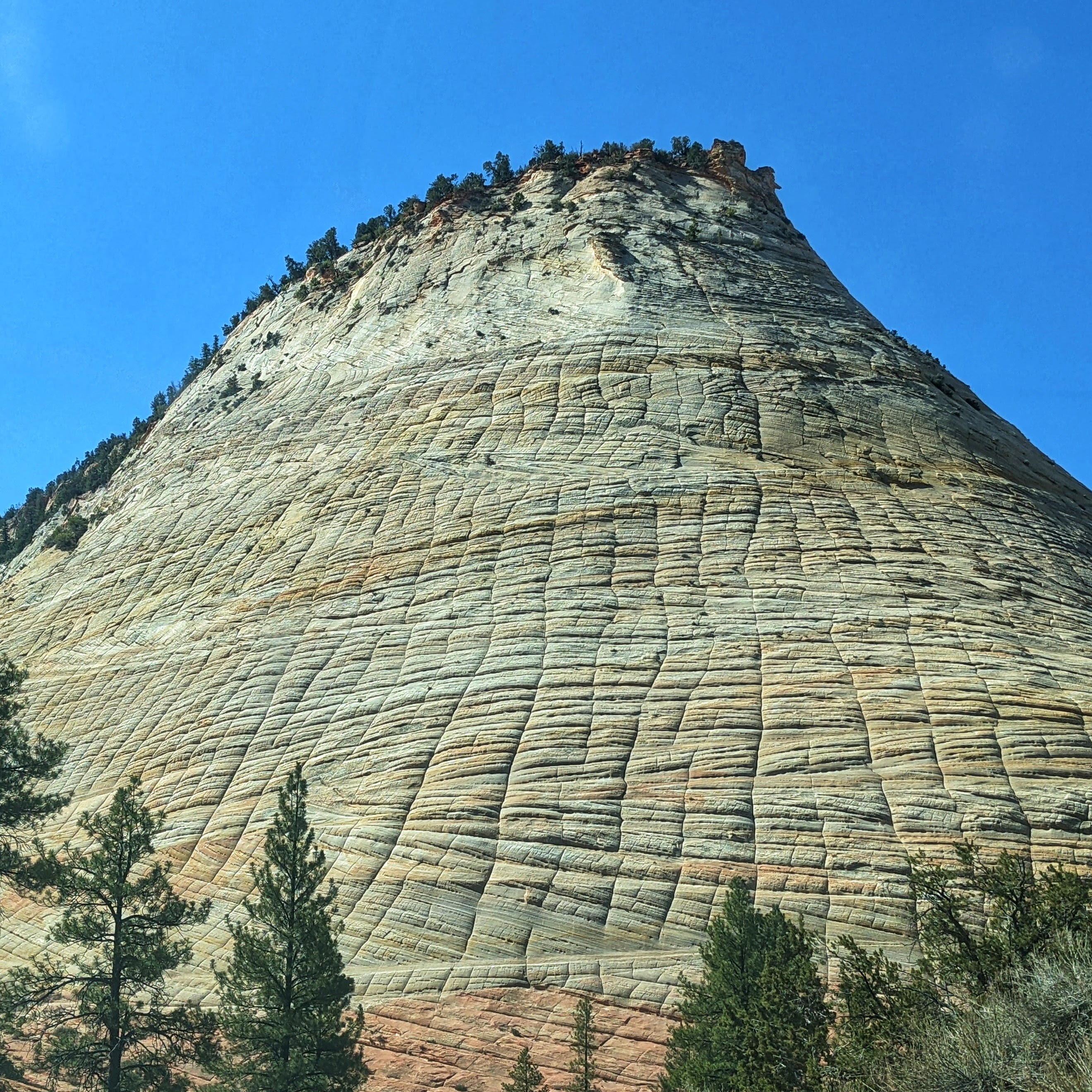
Checkerboard Mesa, Zion National Park
My companion and I entered from the East and were struck first thing by a feature known as Checkerboard Mesa. The distinctive pattern after which it is named is due to cutting of sub-horizontal cross-beds that formed when ancient sand dunes were deposited and then lithified or transformed into rock. These features are useful to geoscientists because they give information about the depositional environment. Specifically, one can discern – among other things – the direction of flow of the medium that carried the particles of sand (in this case wind). Nearly perpendicular to the horizontal plane, are vertical fractures that are caused by a type of physical weathering known as freeze-thaw cycles. Essentially, water infiltrates spaces within the rock and if the temperature drops low enough, the water freezes and expands. This is followed by the reverse process of thaw and – subsequently – contraction when the temperature rises again. Temperature cycling therefore results in stresses being exerted on the rock which in turn leads to fracture. Because the fractures cut across the sedimentary strata, we know that they formed after the beds were deposited. This is an example of a so-called cross-cutting relationship.
Overall, the combination of processes makes for a pretty neat looking first glimpse of this National Park!
Until the next piece of this place of peace (Zion), I’ll leave you with some Edward Abbey:
“Each thing in its way, when true to its own character, is equally beautiful.”
This past February, I turned 33 years old and for the first time in my life, I went skiing. Now, it may strike you as strange that someone like me – so obsessed with mountains – had spent 33 years never descending a snowy mountain slope in one of the most exhilarating ways. However strange it may seem, it was true.
So the weekend of my 33rd birthday I decided to change this. I ventured to Flagstaff, AZ – about 3 hours north of my home in the Phoenix metropolitan area – and spent the next two days enjoying the city of Flagstaff and learning how to ski.
It started with a lesson. We learned the basics: how to wear the boots, how to attach the skis, how to move forward, how to move sideways, how to turn on flat ground. Then we moved to more advanced skills: how to descend a small slope, how to turn while going downhill, how to stop yourself, how to speed up, slow down, turn slowly, turn quickly.
After about an hour of this we hit the bunny slopes! I started going downhill moving left and right to negotiate the other people on the slope and then I lost control. I was gaining speed and making a “pizza” with my skis wasn’t slowing me down, so I did what felt like the best thing to do at the time was – I let myself fall. I stopped about one foot from the snow blowing machine. It was awesome!
I continued to ride the bunny slopes for that day and the next and on my second day even took the lift to a beginners slope up the mountain. I only ended up falling that first time and I loved every minute of the entire experience.
The thing that struck me the most, however, was how much I enjoy beginning something new. I love the feeling of not knowing how to do something and then slowly and incrementally gaining skills that lead to first just becoming somewhat capable and then maybe later becoming quite skilled. My love of this journey of development and exploration is likely why I’ve spent so much of my life as a student, and why I decided to pursue higher education.
I used to get anxious when I’d reflect on this quality I possessed. For example, I used to switch majors when pursuing my undergraduate degrees, then when I finally picked a discipline I later decided to switch to a new field entirely, I’ve left jobs to pursue something new, I’ve moved all over the country, I’ve ended long-term relationships, I’ve changed my diet, I’ve started hobbies and then abandoned them. I felt like I lived in a constant state of flux with no real constant to hold onto. I felt like I’d never “land”, like I’d never know what I wanted to be “when I grew up”.
But through all of that change I finally realized what the constant was: I was still me.
And over the past few years since I’ve posted last, I’ve discovered more about who that person is. I’ve focused on improving my mental wellness and I’ve learned to love me for me.
I used to base my worth on external means of validation, on my accolades, my accomplishments, how other people recognized me and my value. Now I’m content with who I am and focus more on my relationships with family and friends and my general well-being.
While I still have work to do, I love that I love to be a beginner because that allows me to constantly be challenged and to discover more about myself and the world around me. It also encourages me to continue my pursuit of deeper knowledge about my chosen craft because I can incorporate information and skills from a broad range of disciplines as I work to become an expert at being a beginner.
Today is International Women’s Day and I’m celebrating by reflecting on what it has meant to me thus far being a female in STEM.
I currently study geoscience but before that I was an engineer. As a female in engineering I quickly learned that I was a minority. I remember very clearly the first time I admitted this to myself. It was the first day of one of my introductory engineering courses and the professor had all of the students give a brief introduction of themselves to the class. When it came to be my turn I said “Hi, my name is Stephanie, I’m interested in chemical engineering, and in case you didn’t notice, I’m the only woman in the class.” I got some laughs from my classmates (and the professor!) for that one.
During a break in that same class one of the other students came up to me and said, “Is this common, for you to be the only female in an engineering course? That doesn’t seem right.” I was surprised and delighted that my comment impacted at least one student. I then responded with, “well, there are definitely other female engineering undergraduates, and last semester there was one other woman in my programming class”.
I continued to navigate through my program of study, seeing more female students as I advanced to higher level courses. However, we were never the majority. I was the only female in both of my research groups and all but one of my mentors during that time were male. I was lucky though, I never felt like I was treated differently for being female and I was able to succeed.
Following graduation, I spent a few years doing science and technology policy at the Department of Energy. My boss at the time was the Acting Director of the Office of Science, Dr. Patricia M. Dehmer. Dr. Dehmer is one of the most intriguing women I have ever met. She was this petite, softly-spoken woman but she had a prominent, influential presence that demanded respect. She an accomplished scientist and understood the nuances of managing not only people but also complex, large-scale scientific projects.
She was the first woman in a leadership position that I had served under and she taught me some of the most important lessons I would ever learn. I’ll never forget when she told me that when she was a young researcher she was timid like me, but then she realized she would never achieve success if she continued to try and blend into the background. She told me that I was the authority on my projects and actually made me believe that for the first time. She told me that if I expected others to have confidence in my work then I first needed to have some confidence in myself.
Female colleagues in the School of Earth and Space Exploration at ASU.
I still struggle with confidence issues, but I’ve come a long way since then. I’m no stranger to imposter syndrome (nor is ANY other female graduate student I’ve EVER met). But a lot has changed since that day when I realized I was the only woman in the class. I’m now in a Ph.D. program where most of my extremely impressive colleagues are female, I share a building with some of the most accomplished female geoscience researchers in their respective fields, and even the Director of my School is a woman.
I can’t stress enough the importance for females in STEM disciplines to have people in leadership and mentorship roles that advocate for equality. We don’t just need more diversity throughout the entire academic “pipeline”, we also need a culture of respect and dedication to fair and equal treatment for everyone in STEM and from everyone in STEM.
I think back now to this past holiday season. I was gifted the book “We Should All Be Feminists” by Chimamanda Ngozi Adichie. In it, the author argues that feminism shouldn’t be viewed as a negative label available only to needlessly embittered women (as it often is). Instead, feminism should be embraced by all because achieving equality requires equal dedication to it from everyone in a community.
Perhaps you’ve heard the news. The great tectonicist Eldridge Moores passed away unexpectedly. With great sadness, I reflect on the ways he’s impacted me as a geoscientist.
Eldridge Moores was the main character in Assembling California, the final book of John McPhee’s Annals of the Former World series on geology (an excellent read if you’re not familiar). I remember reading the series when I was first getting into geology and imagining myself doing all of the exciting things recounted in the books. Now I get to do those things and I’m extremely grateful for that.
I met Dr. Moores in 2015. I was attending the meeting of the Geological Society of America in Baltimore, MD. At the time, I had very little understanding of geology and the major players in the field but I had a productive meeting nonetheless. One of the sessions I frequented at the time was on connections between tectonics in the United States and tectonics in Asia. Eldridge Moores was in all of the same sessions and his enthusiasm about the subject resonated with me greatly. I’d like to think he had some influence on my decision to become a Himalayan geologist.
Although I only met Dr. Moores briefly, I’ll never forget him. He was an excellent man and amazing geologist and his death leaves a hole in our tight-knit community.
Today I accompanied a new friend and colleague to REI to try out and purchase some climbing gear. His name is Laurence Tognetti (@ET_Exists) and he’s a fellow graduate student at the School of Earth and Space Exploration at Arizona State University (ASU).
Just having started at ASU myself, I’ve been eager to get out and see some of the local geology but haven’t had a lot of opportunities yet. I’m still settling into my new research group and trying to keep up with a heavy course load while also trying to prepare my M.S. defense, so I’ve been pretty busy.
We decided to head north of Tempe into Scottsdale, first enjoying lunch at Rehab Burger Therapy. I got a veggie burger, which was quite good. Then we headed to REI and Laurence got outfitted for rock climbing, accomplishing our primary goal. On the way back to the Phoenix metro area, we passed a striking outcrop of red rock with large clasts contained within it. I felt the urge to stop and investigate so we made a U-turn and set off geologizing.
Lunch in Scottsdale
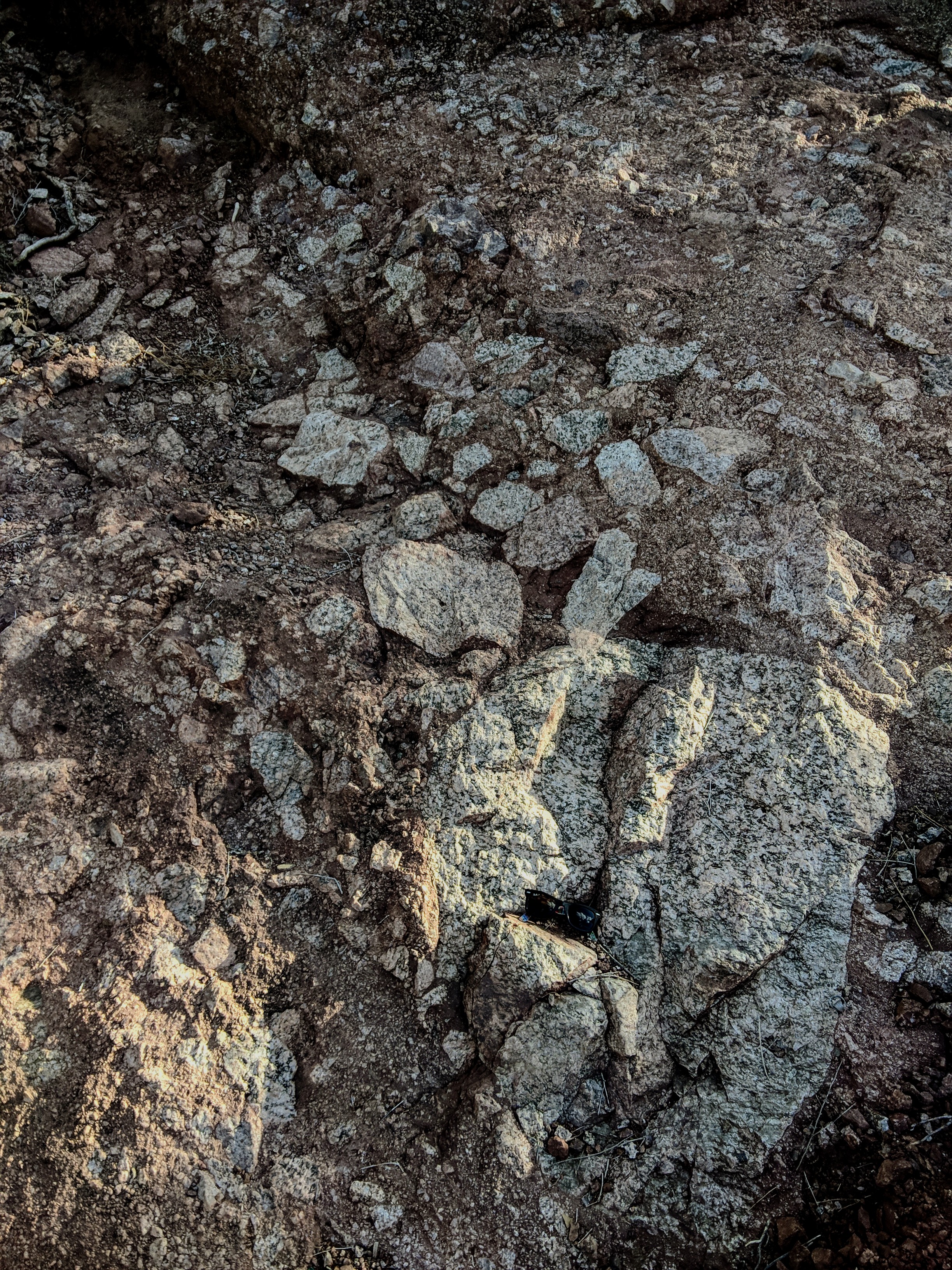
The first thing we noticed was different-sized boulders of granite and quartzite. Farther along the path up the butte, we began to see the bedrock. This butte (named Papago Butte) appeared to be composed of a sedimentary breccia, with large clasts (some bigger than us!) of granite and quartzite. The matrix material was a striking-red fine-grained sandstone.
Camels Head Formation sedimentary breccia. The light-colored clasts are granite and the matrix containing them is sand (sunglasses on largest clast for scale).
Breccias are defined by highly angular clasts that exist in a finer-grained matrix material. Consequently, the sediments making up the rock are extremely variable in terms of their size. Geologists say that they are “poorly-sorted”. Conglomerates share this characteristic with breccias; however, the larger clasts in conglomerates are rounded instead of angular. The poorly-sorted character and angularity of the clasts in breccias tell geologists that those sediments didn’t travel very far prior to deposition and didn’t spend much time being reworked by surface processes prior to being lithified into rock. So basically, something pretty drastic (and fast) happened to put these sediments in place.
The current hypothesis is that about 17 million years ago, there were mountains composed of granite and quartzite. One day, a large landslide brought pieces of these mountains into a nearby riverbed. The breccia (along with other river sediments) was trapped between down-dropped blocks of bedrock that resulted from faulting associated with stretching of the crust (structures called half-grabens). The events resulting in the formation of these structures is known in central Arizona as the Mid-Tertiary Orogenies (because they occurred between 42 and 15 million years ago). The source of this orogenesis was the steepening of the angle of a subducting slab of crust that had broken off from what is now the western coast of North America.
Since that time, surface processes have eroded the landscape. The most obvious erosional feature we observed was tafoni. These are essentially large, cave-like pockets that form in different types of rocks. I had become accustomed to seeing lots of tafoni in the Red River Gorge in Kentucky so this was a welcome sight for me.
Features of Papago Buttes: sedimentary breccia in the foreground, tafoni in the background (vegetation for scale).
We spent about 15 or 20 minutes in the middle of the afternoon out there. Since it’s August, the sun was REALLY intense. I haven’t done much mid-day outdoor activity since moving to AZ but the elements here are more extreme than I anticipated. By the time we were back in the car, I had finished my water and noticed I was getting a headache. Dehydration happens quickly in the desert, so I know to be better prepared next time!
I’m from Virginia, and for that reason, I’m pretty partial to it compared to other states in the USA. In fact, I have this memory from elementary school chorus during which we sang a song called the “Fifty Nifty United States.” At the end of the song, patriotic school children are to exclaim that their home state “is the best of the fifty nifty United States.” In my case, Virginia earned that title, and I still believe that after all these years.
I also began learning geology in Virginia, so the foundations of my geologic knowledge are based upon Virginia’s regional characteristics. The first geology course I took was called “Regional Geology of Great Falls Park, Virginia” and the very first thing we were taught during that course was the physiographic provinces of the state.
Virginia is separated into five provinces that run approximately NE to SW and include (from west to east): the Allegheny (Appalachian) Plateau, the Valley and Ridge, the Blue Ridge, the Piedmont, and the Coastal Plain. About a year and a half ago I was traveling to Georgia with some other University of Kentucky geology students, and as we passed some of these provinces, I became excited and remarked that we were entering a physiographic region with which I shared some history. This earned me a nickname close to “province [queen]” but a little less appropriate for online publication.
Physiographic map of the mid-Atlantic region. The yellow line marks the approximate location of the southern border of Virginia. (Image courtesy of the United States Geological Survey, source for annotated image)
As a “province queen,” over the next two posts, I’d like to recount some recent experiences during travels across some of these areas in the last week or so. I left Lexington (crossing the Allegheny Plateau) to participate in a trail race in Blacksburg, VA and to visit my husband in Radford, Virginia. Blacksburg and Radford are parts of the greater New River Valley, one valley that makes up the “Valley and Ridge Province” in Southwest Virginia. The province is given this name because of the “crinkled carpet” sort of topography that exists there. The valleys are underlain by rocks (like carbonates) that erode easily while the ridges are made up of more resistant sandstones and conglomerates. Before being eroded, these rocks were deformed during Appalachian mountain building. They responded to contractional stresses by folding and thrust faulting along weaker rock layers in an orientation consistent with the distribution of stress associated with the collision (perpendicular to the direction of force).
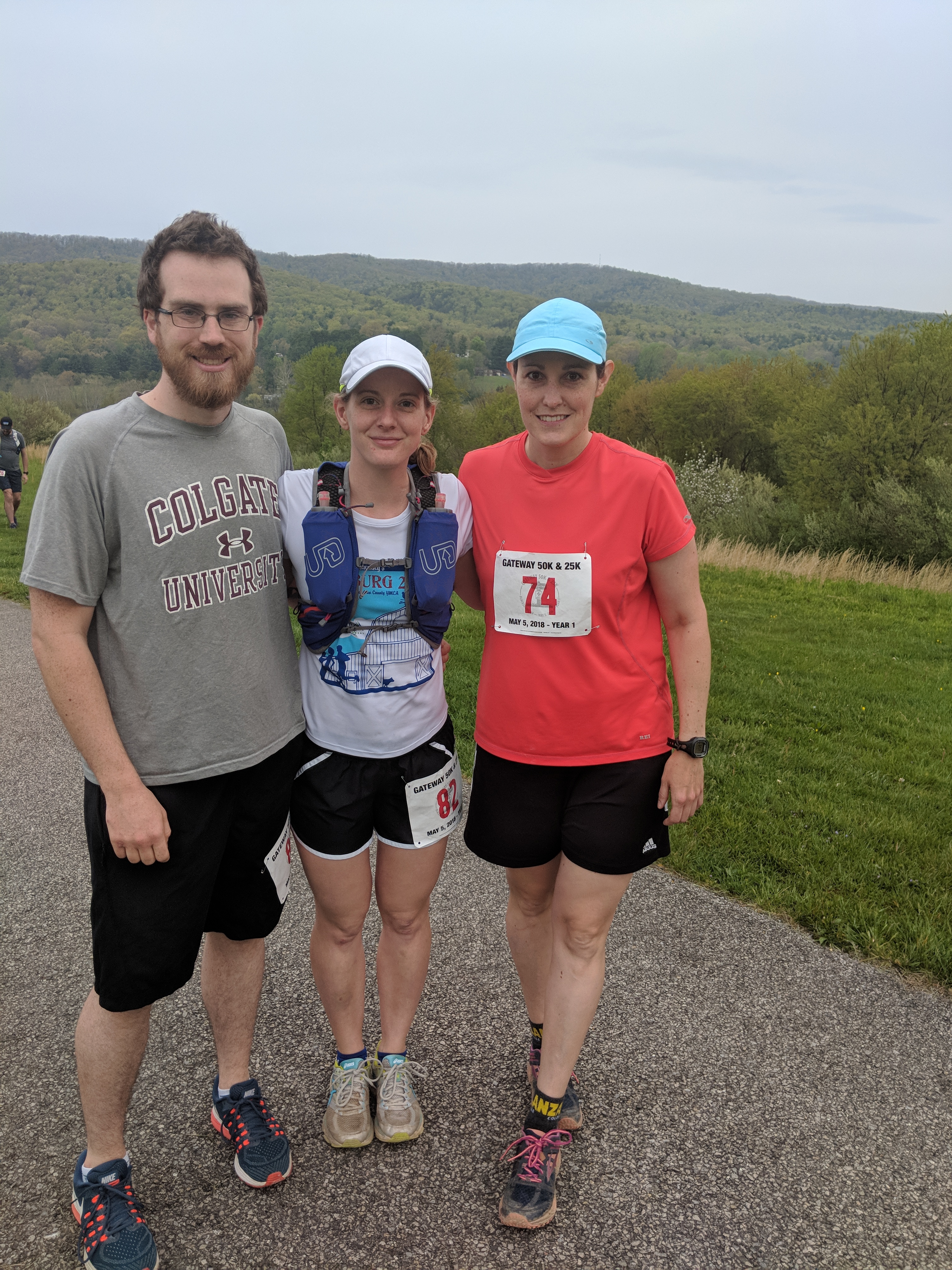
Friends and I pre-race with scenic valleys and ridges in the background near Blacksburg, VA
A couple of days after the race, I spent a half-day with my husband near Floyd, VA. We drove to the Blue Ridge Parkway to do a trail run and then enjoyed some wine at Chateau Morrisette, which is nearby. The Blue Ridge Parkway is a road that runs through another physiographic province (can you guess which one? Correct, the Blue Ridge!). As in the Valley and Ridge province, the rocks that make up this province were exposed during Appalachian mountain building: they were deformed and transported along faults. The rock types that make up this province; however, are different from those rocks that make up the Valley and Ridge. Exposed along the Blue Ridge are “basement rocks” that have deeper, more “complex” origins: they show evidence of an even older period of mountain building that happened prior to the formation of the Appalachians. This “basement-involved” process exposed older metamorphosed volcanic and sedimentary rocks that erode differently than those in the Valley and Ridge and therefore result in different topography.
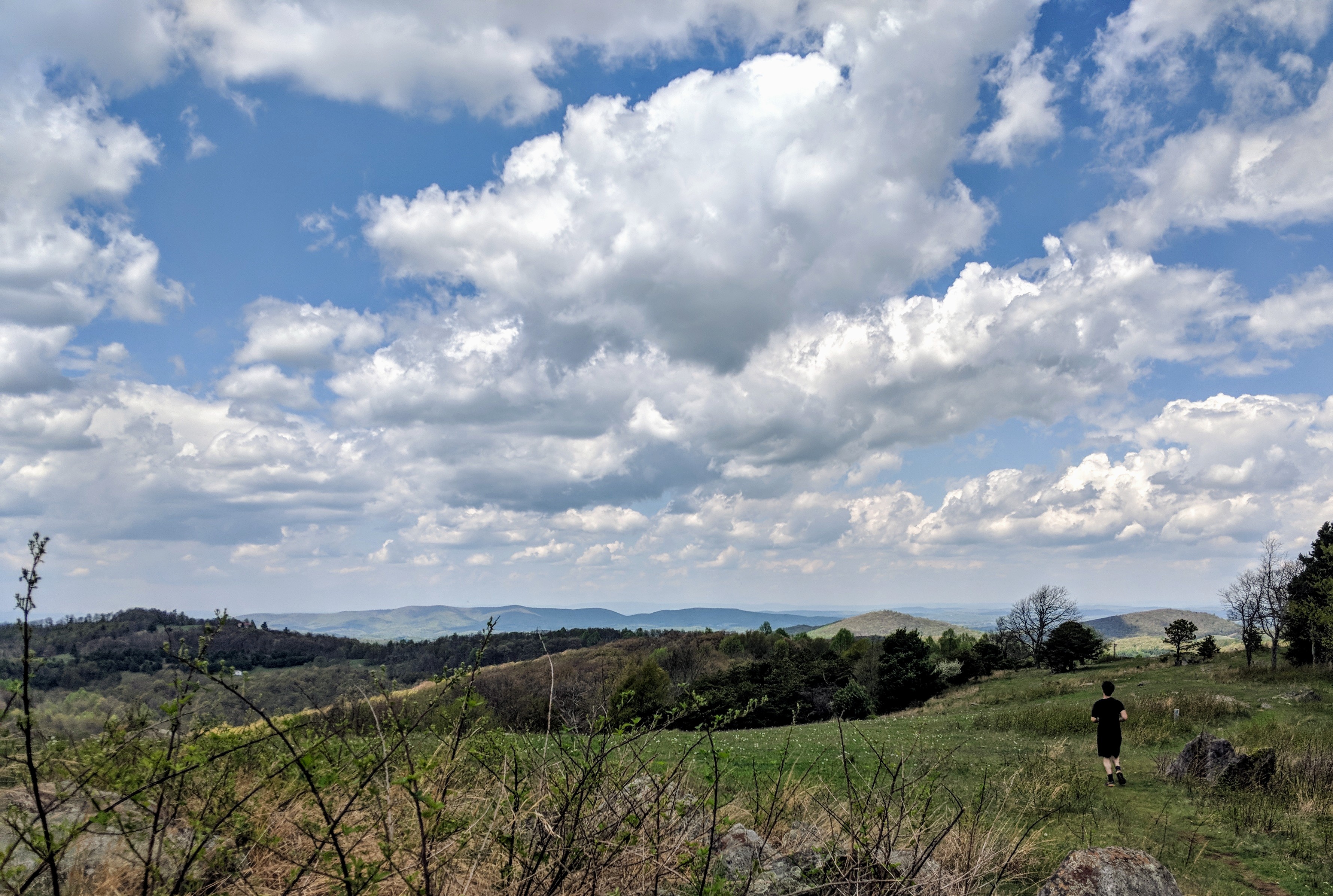
Running along the Blue Ridge Parkway: views to the west show the nearby Valley and Ridge province.
This topography – which has been evolving over several millions of years – creates breathtaking views that make running along trails and relaxing with a glass of local wine one of the most pleasant experiences!
There’s plenty more Virginia travel and geology to discuss in my next post: Virginia is for (province) lovers: Part II. Stay tuned!






 OROGENY ODYSSEY