The University of Kentucky Graduate School participates in a national program called Preparing Future Faculty (PFF) that aims to introduce graduate students to the realities of faculty careers. As someone who one day seeks to serve as a member of the professoriate, I elected to participate in this program.
By association, I was recently tasked with seeking out a mentor at a higher education institution of interest in order to better understand the day-to-day responsibilities of faculty members. I reached out to Joe Allen, a structural geologist who chairs the Department of Physical Sciences at Concord University, requesting he serve as my mentor and he graciously agreed.
I chose Concord University because it is a small public university with an undergraduate focus. I don’t have much experience in this realm (myself a product of large research universities and community college). I was, therefore, excited to hear the perspectives of Dr. Allen and his colleagues.
Late last week, I embarked on my journey to Athens, WV where I was first met with what every eager career-builder seeks: my own reserved parking space.

Reserved parking right next to the Provost.
Regarding first impressions: I suspect Dr. Allen had me visit on that early November day because he knew the collegial brick buildings with ivory trim flanked by deciduous hardwoods hanging on to myriad-colored leaves standing against the smoky blue backdrop of the Appalachians is the stuff university marketing materials are made of. Perhaps not, but the campus is quite attractive regardless.
I entered the science building which is home to Departments comprising the College of Natural Sciences, Mathematics, and Health. The building exhibits a museum-like quality with displays of taxidermied endemic animals, preserved fungi, fossil collections and the like. I found Dr. Allen’s office on the top floor. His space is shared with student workstations, one of many signs pointing to an emergent theme of close student-faculty interaction.
Dr. Allen met me after one of many meetings he’d squeezed in between his teaching commitments throughout the morning. I asked him when he’d had time to eat his lunch. He responded with “It’s sitting in the fridge”.
We headed downstairs to meet students in his structural geology lab. Most of the students were traditional sophomores. All students possessed an impressive degree of maturity and a distinctive worldly view consistent with broader-level thinking. After a brief Q&A session meant to clarify some questions from previous weeks’ lab assignments, Dr. Allen proposed a field trip to the nearby boundary of the Appalachian foreland fold-and-thrust belt. One student was wearing yet-to-be broken in field boots so the class opted for the trip.
We first headed to the ominously-designated “Bridge to Nowhere”. An unfinished section of highway in Bluefield, the area has served as Dr. Allen’s “natural laboratory” for years. Recent funding influx provided as part of West Virginia’s Statewide Transportation Improvement Plan threatens access to this fortuitously-located outcrop. Therefore, Dr. Allen is recruiting undergraduate research assistants to help document the geologic features exposed there using the school’s newly acquired UAV.
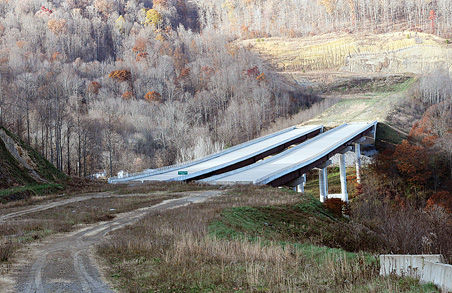
Bluefield’s Bridge to Nowhere (source: Bluefield Daily Telegraph)
We stopped here and at other field stops, including an impressive fold that’s part of a regional structure. At each field stop, students took measurements of structural features and made multi-scale observations that will be added to a comprehensive report on the local structural geology. Overall, these field excursions provide a dual benefit: students get hands-on experience doing field mapping, making observations and integrating knowledge from multiple classroom-based courses and Dr. Allen has the opportunity to collect field-based data and contribute to his ongoing scholarly research.

Dr. Allen (orange jacket) introduces students to the outcrop.
During the ride back to campus, I had the chance to chat a bit with some seriously impressive students. I met Dustin, who had a nearly encyclopedic knowledge of music, film, and literature and Jazz, who asked piercing questions like what my impression was regarding themes in socio-economic affairs in the Appalachian region. The student benefit from focusing on quality teaching in undergraduate courses became abundantly clear. Students produced by Concord University are no doubt set up for successful careers in the geosciences and beyond.
Stay tuned for more on my visit.

Jazz provides scale for a block of rock that fell from the outcrop. The radiating pattern is called plumose structure and shows the propagation of extensional brittle fracture.
 A few weeks ago, I headed out to Seattle, WA to attend the 2017 Annual Meeting of the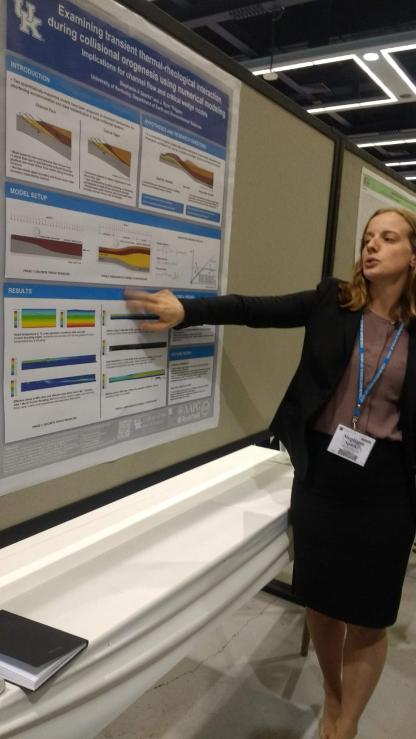

 Last year, at the start of my graduate education, I was given the assignment of describing my research (or what I thought it would be at that somewhat premature point) using only the thousand most commonly used words in the English language.

