Machhapuchare: “Like a spire of a higher kingdom”

I study the Himalaya, and I’m not alone. Many geologists for many years have gone to South Asia to attempt to understand one of the most magnificent orogens on Earth. It’s also commonly referred to as the “type example” for continent on continent collision and is usually the first of this type to come to mind for most students of geology. The Himalayan mountains and the Tibetan Plateau to the North formed as a result of the collision between the Indian subcontinent and the Eurasian tectonic plate which began about sixty million years ago. Since both plates are made up of continental lithosphere, the crust thickened at the convergent boundary, and the Himalaya peaks uplifted. Weathering and erosion by glaciers and rivers at the surface also sculpted these peaks. All of this combined created some of the most beautiful mountains in the world.

I study the complex processes at work during this type of tectonic event using computer simulations. I also like to have a way to “ground-truth” my numerical models so one year ago I traveled to the field with my colleagues to collect rocks along transects that span the major rock units and faults in the Himalayan range. We trekked to the Annapurna region along the Modi Khola and Marshyangdi Rivers in central Nepal collecting rocks, taking measurements, and making field observations.

20170503_085612

Farmed foothills en route from Kathmandu to Pokhara

As my first time in the Himalaya, I was beyond excited to have this opportunity. Also, since I didn’t study geology as an undergraduate, this gave me a chance to develop some skill in field methods.

20170503_112009

Enjoying Dal Bhat for lunch along the Trishuli River

There is a lot I can write about regarding that field season, and I hope to cover it across many entries. For this post; though I want to describe the first time I saw one of those magnificent Himalayan peaks.

The Himalaya is unique in that it has some of the highest topographic relief in the world. The difference in elevation changes very dramatically in this region. Due to this relief, as one approaches the high Himalaya, there is an abrupt change in climate such that at one moment it feels almost like a jungle and the next there are snowfields and glaciers everywhere.

20170506_055939

Machhapuchare at dawn.

I was riding in a jeep from Kathmandu with my colleagues observing the tree-covered foothills and cloudy skies associated with the onset the of monsoon season and then all of a sudden I saw it – a blinding white abstraction proffering from between the clouds – Machapuchare. As the first Himalayan peak to which I’d bared witness, and rhapsody challenging to describe overcame me. To see something that beautiful but with such threatening presence flooded my being with complex emotion. I’m not the only one to feel this way. In fact, I will borrow some words from my favorite writer, Peter Matthiessen:

“[Four] miles above these mud streets of the lowlands, at a point so high as to seem overheard, a luminous whiteness shone – the light of snows. Glaciers loomed and vanished in the grays, and the sky parted, and the snow cone of Machhapuchare glistened like a spire of a higher kingdom.”

Stay tuned for more on Macchapuchare.
#ImAGeoscientist

Today is Earth Day, which is a pretty important day for people like me. Perhaps you’ve seen the trending #IAmAGeoscientist (#ImAGeoscientist) posts around social media associated with the American Geosciences Institute’s (AGI) effort to celebrate this day by highlighting the efforts of those the people that study the Earth and its complex systems.

I’m proud to proclaim that #IAmAGeoscientist too; because in being that, I get to be myself. My discipline lets me do all of the things I enjoy and study the things that inspire me without ever sacrificing those things that make me – well – me.

Geoscience permeates through my being and influences most things that I do. This compatibility exists because the activities in which I engage, the thoughts that infiltrate my mind, and the phenomena that captivate me day-to-day all involve my craft.

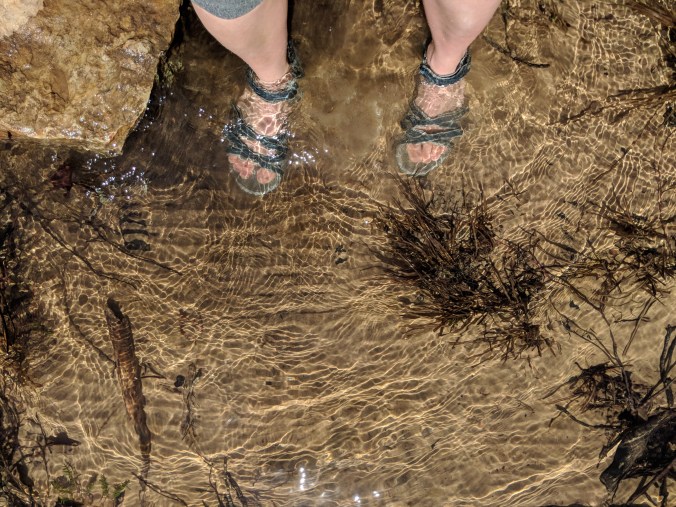
For example, yesterday I spent about half of my day relaxing with my husband. We went to visit a waterfall in Southwest Virginia and then went on a hike through the Valley and Ridge province of the Appalachian Mountains. I had a great time hiking, crossing streams, climbing rock formations, and meditating in the noisy tranquility of wilderness. I reflected on the regional geology – to which I’ve been fairly well-exposed – as well as the implications of myriad features presenting themselves to me. My main purpose wasn’t science, but that aspect never really leaves my mind.

Maker:0x4c,Date:2017-11-10,Ver:4,Lens:Kan03,Act:Lar01,E-Y

Ripples forming in stream sands, Dismal Creek, VA

Then there were the events of today. I spent most of my time on my computer. I am running numerical models, creating figures for a manuscript, and putting together a scientific poster for a workshop I’m attending next week in Colorado.

Maker:0x4c,Date:2017-11-10,Ver:4,Lens:Kan03,Act:Lar01,E-Y

Scenic valleys and ridges in Southwest Virginia

The point is that being a geoscientist is multi-faceted. Sure, we get to go to the field, observe the natural world, and explore wild and exotic places. We also get to work long hours in laboratories, perform tedious analyses, and attempt to interpret results that can be pretty darn daunting sometimes. Then we get to think about the broader implications of our science: we get to interpret our findings in ways that resonate with the community-at-large and beyond as well as attempt to engage outsiders (through policy, education, and outreach) that are less familiar with our work.

Like I mentioned before. It’s multi-faceted, but I love each and every aspect. In fact, there is no other label that I’d rather give myself than Geoscientist.

Off to the Races

I’ve been living in Kentucky for almost two years now, having moved here to work towards an M.S. degree in Geology at the University of Kentucky. Prior to moving to Lexington, the only thing I really knew about the Commonwealth was that it was well-known for Bourbon, Bluegrass, and horses. I have fond memories of chatting with my friends back home about moving to Kentucky, ironically sporting a flamboyant hat, and sipping Mint Juleps at Churchill Downs for the Kentucky Derby. My desire to do so was somewhat based off of a morbid curiosity that I picked up after reading the short essay “The Kentucky Derby is Decadent and Depraved” by gonzo journalist Hunter S. Thompson. That story was written during a time with a different degree of civil unrest than today, but I figured there were elements of the atmosphere that may persist and could likewise permit an interesting cultural experience.

Unfortunately, I likely won’t get the chance to actually attend the Kentucky Derby. I spent last year in Nepal doing field work during the event and will be running my first ultramarathon in Virginia this year. So, unless life brings me back to Kentucky some early May, I’ll have to celebrate it remotely like so many others.

To make up for this; however, I accompanied the week’s seminar speaker to the Keeneland race track in Lexington for my first thoroughbred sporting event. Departmental seminars are common in the sciences (as well as many other disciplines). They offer the dual benefit of affording students and faculty members an opportunity to hear about research that others have been conducting as well as expanding professional networks by interacting with scientists outside of the home institution. For this particular seminar, Prof. Eric Ferré from Southern Illinois University presented on some work that stemmed from his time cruising with the International Ocean Discovery Program (IODP).

The IODP is an international research program that focusses on extracting cores of rock from deep within the Earth from below the sea-floor. IODP research vessels explore our planet’s vast oceans with the goal of gleaning information about that part of the Earth which we still don’t fully comprehend. For his talk, Dr. Ferre introduced audience members to a type of rock within oceanic crust that forms in so-called “fast-spreading” centers in a transition zone between sheeted dikes – where ocean water mixes readily with newly forming igneous rock – and less permeable rock that doesn’t see as much hydrologic influence (gabbro). Interestingly, this transition zone rock is also observed in ophiolites or oceanic rock that has made its way onto continents through a process called obduction.

I spend most of my time thinking about continental crust, which has a different composition than oceanic crust and therefore different properties. I was; however, able to draw parallels regarding how certain thermal and mechanical properties are affected by zones of transition within these different types of crust. With this idea in mind, Dr. Ferré and I were able to discuss elements of our research that may be complementary and forge out a tentative plan for future collaboration.

We happily discussed our respective projects between each of the exciting races at the Keeneland track. All the while I sipped on a Keeneland Breeze (not quite a Mint Julep) and we all did some crowd-observing (no extravagant hats, though).

MVIMG_20180413_174511

A Journey to “The Gateway to Hell”

I mentioned before that I traveled to Iceland this past summer. I saw a lot of seriously incredible geology on that trip so the locale is likely to manifest in many posts.

On our second full day in the country, we went north from the Ring Road to visit the Hekla Volcanic Area. Hekla – also known as “The Gateway to Hell” – is one of Iceland’s most active volcanoes. After at least 250 years of dormancy, the first recorded eruption of the volcano occurred in 1104. Since then it has had more than twenty significant eruptions, with the last one occurring in 2000. Hekla is also unusually aseismic (it doesn’t produce earthquakes) and activity only starts about an hour or less before an eruption. Considering it took more than 30 minutes to drive to the parking area and we spent about 3 hours on the volcano itself, we would have certainly not survived in the event of an eruption. We were, of course, well aware of this. The Icelandic government; however, graciously reminded us of our poor decision with the following sign.

20729223_10212345334021596_6973221120480303905_n.jpg

Sign warning us of the danger involved in climbing Hekla

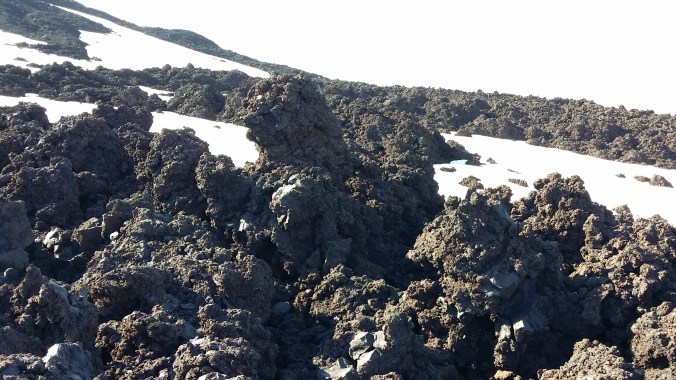
Abandoning all common sense we went for the summit: and we had an amazing time. Along the way, I observed some of the interesting features of this volcano. Hekla is a stratovolcano, a name given to volcanoes with cone shapes that result from layers that form from material associated with alternating types of eruptions. Some eruptions produce gentler lava flows because they are composed of minerals that yield lower viscosities (like warm maple syrup). Others eruptions are incredibly violent and produce explosions of high-viscosity lavas as well as tephra, pumice, and thick ash. I found features associated with both types during my visit.

Ropy

Flow patterns are seen in hardened lava and are likely associated with a lower-energy phase of eruption.

BlockyLava

Blocky flows and tephras from explosive eruptions.

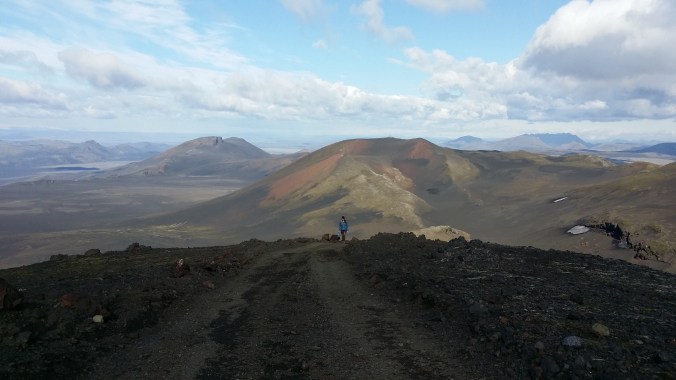
Hekla is also part of a ridge where volcanic material erupts through large fissures. These fissures run parallel to and are associated with the Mid-Atlantic Ridge, or boundary between the North American and Eurasian tectonic plates where new oceanic crust is generated as the Atlantic Ocean continues to open.

Ridge

Ridge of volcanoes seen from Hekla proper. The different colors are from the different types of iron oxides that make up the lavas.

Standing at the summit, enjoying the views and consuming some well-earned snacks, I began to contemplate the continual evolution of the landscapes beneath my feet. The mere impermanence of the entire island is simply awesome. With every eruption, the volcano’s surface is formed anew but the peak upon which I stood exists as an amalgamation of several such events. As a geologist, I’m often presented with information that forces me to think along time scales which are much longer than what most people are used to and can be challenging to comprehend. However, it’s also refreshing to observe first-hand the rich dynamism of our ever-changing planet.

SummitView

View from the summit of Hekla.

Perhaps that’s why I’ve come to learn to be mindful of these experiences as they occur; but also, reflect on the fact that the processes I’m observing are everlasting. Perhaps also, it is why I feel a little less hesitant to engage in activities where death seems a little more imminent.

“Do nothing in haste; look well to each step; and from the beginning think what may be the end.”

About three years ago I read the book The Invention of Nature by Andrea Wulf. In it, the author describes the life of Alexander von Humboldt, the Prussian scientist and explorer who strongly influenced a young Charles Darwin. During this time, I was seriously contemplating pursuing geology for my life’s work but had yet to delve into the subject fully. I found solace in the storied history of Humboldt, a man I viewed to possess traits of being that I someday wished to emulate.

A master of myriad disciplines, Humboldt characterized what I believe was the paragon life of the natural scientist unbound. Not only did he engineer his own instruments and culminate varied and complex – yet complete – datasets on some of the most magnificent but previously undocumented features of the natural world, he also excelled at public relations and scientific policy. Humboldt’s arduous push to explore the Americas and connect with its peoples inspired generations of civil development and social and environmental progress which to this day continues to be colorful and complex.

20161229_141844

Alexander von Humboldt Monument, El Ejido, Quito, Ecuador

I came to regard Humboldt as a being by which I felt inspired. I’ve recognized my tendency to identify esteemed individuals after which to model my actions as a trend which has followed me through my life. In fact, in my earlier years of self-reflection, I often deemed myself too impressionable: a quality I didn’t always embrace as beneficial to my development. I have since learned that seeking role models to guide me through first absorbing desirable traits and then incorporating habits into my own identity has helped me grow into a better scientist.

One of the journeys of Humboldt that I found particularly striking was when he climbed Chimborazo, a volcano in Ecuador. The volcano’s great height historically placed its peak as the highest in the world; however, modern instrumentation and exploration led to the discontinuation of that idea. Chimborazo is unique; though, in that its summit is the farthest point from the center of the Earth. Interestingly, our home planet takes the shape of an oblate spheroid: not a perfect sphere. The equator is slightly “fatter” and because of that, features on the surface near the so-called equatorial bulge extend to greater distances from the center. Thus, the summit of Chimborazo – which is at the equator – juts out from the center even farther than that of the majestic Mount Everest.

20170106-085720_orig

Chimborazo

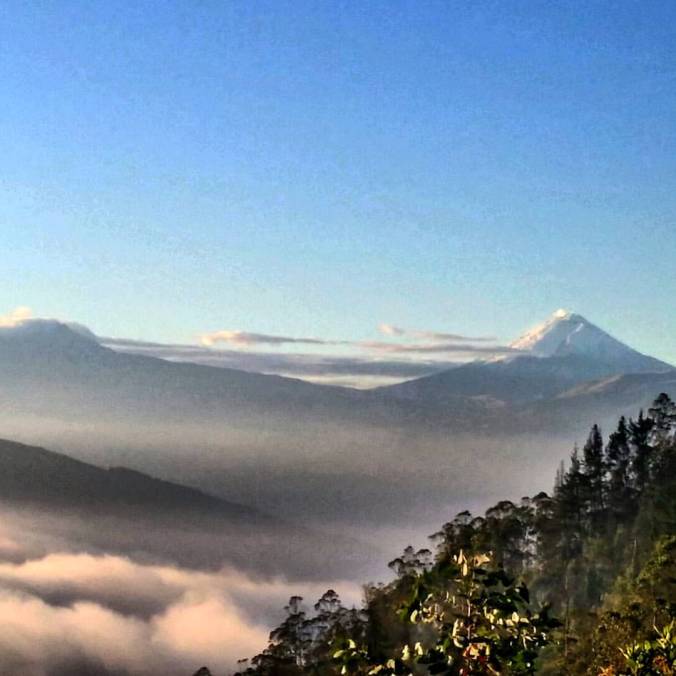
It is for this reason I seek to one day climb to the top of Chimborazo. With this goal in mind, a little over one year ago I journeyed to Ecuador to set my sights on the volcano. I’m still learning the techniques of climbing big mountains, so I did not attempt to summit on this trip. I did wish to get a “feel” for the environment; however, which I achieved. I took a trip to climb to what was at the time the highest accessible point on neighboring Cotopaxi. On my way, I saw Chimborazo in-person for the time and was overwhelmed with awe. From that moment I knew that my actions going forward would be in pursuit of the ultimate goal of standing atop that peak.

15799951_10210308544023119_2355301716659398638_o

Cotopaxi at dawn from Parque Metropolitano, Quito, Ecuador

I now leave you with a short poem I wrote to culminate the themes of my story here. I also hope that you too can find something worth “[looking] well to each step; and from the beginning [thinking] what may be the end”.

PoemChim

Note: quote (and title) are by Edward Whymper, the English mountaineer who is credited with the first ascent of Chimborazo.

A View from Thirty Thousand Feet

One of the things I enjoy about geology is the utility found in drawing upon seemingly disparate pieces of information to better understand the interconnected processes at work on the Earth. In the business world, this is often described as the “30,000-foot view”. Thirty thousand feet is chosen because that is close to the approximate altitude at which most commercial jet aircraft cruise. Just imagine yourself in an airplane, looking at the landscapes passing beneath you, and forming ideas about what you are seeing with this unique perspective. Those ideas are certain to integrate a great deal of information. This approach to forming ideas is particularly useful in geology – which some refer to as “the ultimate interdisciplinary science” – because one gains a level of understanding consistent with the Earth as a complex system.

This sort of thinking sometimes permeates into other aspects of my life. For example a couple of weeks ago I read an article about how scientists for the first time created three-dimensional images of certain quasiparticles (phenomena that occur when particles are affected by interactions in a system such that those particles behave as if they are different types of particles in a vacuum). What they imaged are known as skyrmions, which have been proposed as a model for particles that make up the nuclei of atoms (like protons and neutrons). It is useful to understand skyrmions because they have implications for electronic materials like semiconductors that we use in computers. I hadn’t previously heard of skyrmions and I found myself intent on learning more about them. This could be because my first thought was, “Skyrmion? That’s a strange name that reminds me of Iceland”.


20799248_10212350843919340_7141857515606629887_n

Icelandic cows are necessary for excellent quark.

Iceland is a popular destination for geologists because so many geological phenomena are on display in such a small area. I suppose one could say Iceland gives the geo-tourist a lot of “bang for the buck”. I’m a pretty typical geologist, so I myself vacationed to Iceland this past summer. While I was there I took a liking to a dairy product known as skyr. I later learned that although skyr reminds me of yogurt, it is technically a cheese. It is classified as such because it is made from coagulated milk solids (cheese) rather than thickened milk (yogurt). The proteins in milk normally repel each other and stay suspended in liquid but when certain bacteria are introduced it makes the milk more acidic which causes the proteins to clump together into curds which are used to make cheese. In yogurt, the elevated temperature that the milk is subjected to during production breaks up the proteins which results in thickening.

When I was researching this for myself I also learned that skyr is a particular type of cheese known as a quark because it is made using bacteria that thrive in moderate-temperature environments. The word quark reminded me of the subatomic particles that combine to make composite particles like protons and neutrons. Thus, I arrived back at my initial subject of investigation: particle physics.

Also, in case you are wondering if skyrmions are named after a dairy product, they are not. The person that first proposed them as a model was a British physicist and mathematician named Tony Skyrme.

“It matters that you don’t just give up”

Those who know me well know that I come from somewhat humble beginnings. That’s not to say that my upbringing didn’t serve me well in terms of observing first-hand the value of a strong work ethic. My parents slaved tirelessly working multiple full-time blue-collar jobs to afford to live in a relatively affluent area so that their children might realize a better future, which we now gratefully enjoy. Most significantly, this impressed upon me a system of values to which I can attribute much of my more recent accolades.

As a result, however, when I was growing up it was difficult for me to relate to peers much more fortunate in terms of financial security. My worldview was somewhat removed from those with ample time for more scholarly pursuits. However, in my teen years, I met a young man who introduced me to poetry, high art, music, and literature. This man – who I ended up marrying several years later – taught me the value of using the resource of one’s mind as a tool to gain new perspectives. Exemplary of this was when he lent to me his copy of “A Brief History of Time” by Stephen Hawking.

In my coming-of-age, I was constantly trying new things out. I was seeking an identity that felt genuine. One matter upon which I was often ruminating was that of my faith. Further, I was uncertain how my religious beliefs – or lack thereof – fit into the context of a flourishing interest in subjects based on pure reason. It was therefore timely for me to delve into Professor Hawking’s book. In “A Brief History of Time”, he provides not only an excellent review of how we understand the physical universe but also comments on the implications of making connections between faith and science. It is this part that helped me come to terms with my own definition of God. Professor Hawking, in short, inspired me to generate a unique meaning for faith – one much broader than what I had learned from traditional religious practice and one based on my experience as a student of logic.

To better understand the connection upon which I landed, I quote the philosopher Alan Watts:

“[Faith] is an unreserved opening of the mind to the truth, whatever it may turn out to be. Faith has no preconceptions; it is a plunge into the unknown. Belief clings, but faith lets go. In this sense of the word, faith is the essential virtue of science, and likewise of any religion that is not self-deception.”

In the wake of Hawking’s death, I remember this as one of the more impactful experiences of my youth. I also look to the future with further inspiration to share my science in ways that a greater number of citizens can relate. Stephen Hawking excelled at this, and I can only hope to be a fraction as successful in my own pursuit to become a scientist and science communicator.

As the great physicist said,

“Try to make sense of what you see and wonder about what makes the Universe exist. Be curious. And however difficult life may seem, there is always something you can do and succeed at. It matters that you don’t just give up.”

Source for Featured Image

A Sense of Direction

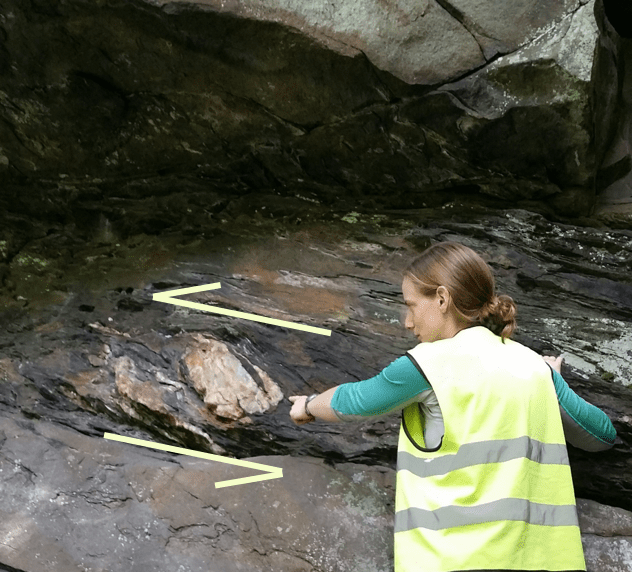
Here’s a picture of me on an outcrop of rock:

20170929_121203

Before I explain what I’m pointing to, I thought I’d provide some context. It was Saturday morning in late September and I was on a field trip for a seminar course I’m taking this semester called “Collisional Orogenesis”. The class covers the processes involved in the evolution of mountains that form when continents collide.

We ventured out to the Tennessee and North Carolina part of Appalachian mountains to gain a field-based perspective. This area was chosen since it is the closest mountain belt that formed in this way and there are some pretty fantastic rocks. We were having a good time driving around, looking at rocks, and camping in truly beautiful places. At this outcrop, some students were unlucky enough to come in contact with stinging nettle while bushwhacking up the hillside. Don’t let that be you!

Maybe you can tell the lower rock I’m standing on differs from the darker rock above my waist. The lower rock is a sandstone and the upper rock is a shale. The sediments that make up these rocks were deposited about 600 million years ago when an ocean basin was forming during continental rifting.

After that, the continents collided resulting in the formation of Pangaea. This generated tectonic stresses that were so great these rocks became deformed. The sandstone (lower rock type) is relatively strong so most of that deformation was taken up by the weak shale layer (upper rock type). We can get a sense of direction of motion because there was a quartz pod in the shale (white blob I’m pointing to) that was rotated as the bounding layers moved past each other. Lucky us!

sparkspod

Not so lucky is being attacked by yellowjackets on the way back to the vans… It’s all part of the job though, I guess.

Faculty Shadowing at Concord University: Part I

The University of Kentucky Graduate School participates in a national program called Preparing Future Faculty (PFF) that aims to introduce graduate students to the realities of faculty careers. As someone who one day seeks to serve as a member of the professoriate, I elected to participate in this program.

By association, I was recently tasked with seeking out a mentor at a higher education institution of interest in order to better understand the day-to-day responsibilities of faculty members. I reached out to Joe Allen, a structural geologist who chairs the Department of Physical Sciences at Concord University, requesting he serve as my mentor and he graciously agreed.

I chose Concord University because it is a small public university with an undergraduate focus. I don’t have much experience in this realm (myself a product of large research universities and community college). I was, therefore, excited to hear the perspectives of Dr. Allen and his colleagues.

Late last week, I embarked on my journey to Athens, WV where I was first met with what every eager career-builder seeks: my own reserved parking space.

23270404_10213039842063863_3559192144230276142_o

Reserved parking right next to the Provost.

Regarding first impressions: I suspect Dr. Allen had me visit on that early November day because he knew the collegial brick buildings with ivory trim flanked by deciduous hardwoods hanging on to myriad-colored leaves standing against the smoky blue backdrop of the Appalachians is the stuff university marketing materials are made of. Perhaps not, but the campus is quite attractive regardless.

I entered the science building which is home to Departments comprising the College of Natural Sciences, Mathematics, and Health. The building exhibits a museum-like quality with displays of taxidermied endemic animals, preserved fungi, fossil collections and the like. I found Dr. Allen’s office on the top floor. His space is shared with student workstations, one of many signs pointing to an emergent theme of close student-faculty interaction.

Dr. Allen met me after one of many meetings he’d squeezed in between his teaching commitments throughout the morning. I asked him when he’d had time to eat his lunch. He responded with “It’s sitting in the fridge”.

We headed downstairs to meet students in his structural geology lab. Most of the students were traditional sophomores. All students possessed an impressive degree of maturity and a distinctive worldly view consistent with broader-level thinking. After a brief Q&A session meant to clarify some questions from previous weeks’ lab assignments, Dr. Allen proposed a field trip to the nearby boundary of the Appalachian foreland fold-and-thrust belt. One student was wearing yet-to-be broken in field boots so the class opted for the trip.

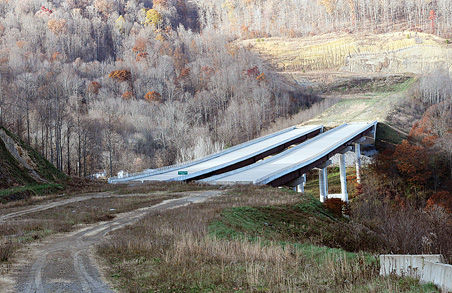
We first headed to the ominously-designated “Bridge to Nowhere”. An unfinished section of highway in Bluefield, the area has served as Dr. Allen’s “natural laboratory” for years. Recent funding influx provided as part of West Virginia’s Statewide Transportation Improvement Plan threatens access to this fortuitously-located outcrop. Therefore, Dr. Allen is recruiting undergraduate research assistants to help document the geologic features exposed there using the school’s newly acquired UAV.


nowhere

Bluefield’s Bridge to Nowhere (source: Bluefield Daily Telegraph)


We stopped here and at other field stops, including an impressive fold that’s part of a regional structure. At each field stop, students took measurements of structural features and made multi-scale observations that will be added to a comprehensive report on the local structural geology. Overall, these field excursions provide a dual benefit: students get hands-on experience doing field mapping, making observations and integrating knowledge from multiple classroom-based courses and Dr. Allen has the opportunity to collect field-based data and contribute to his ongoing scholarly research.


20171108_144742

Dr. Allen (orange jacket) introduces students to the outcrop.


During the ride back to campus, I had the chance to chat a bit with some seriously impressive students. I met Dustin, who had a nearly encyclopedic knowledge of music, film, and literature and Jazz, who asked piercing questions like what my impression was regarding themes in socio-economic affairs in the Appalachian region. The student benefit from focusing on quality teaching in undergraduate courses became abundantly clear. Students produced by Concord University are no doubt set up for successful careers in the geosciences and beyond.

Stay tuned for more on my visit.


20171108_155027

Jazz provides scale for a block of rock that fell from the outcrop. The radiating pattern is called plumose structure and shows the propagation of extensional brittle fracture.


Meeting of the Minds

20171026_132307A few weeks ago, I headed out to Seattle, WA to attend the 2017 Annual Meeting of the Geological Society of America (GSA). The GSA Annual Meeting is held each fall and is one of the largest national conferences for geologists. I attended another one of these meetings back in 2015; however, at that time I wasn’t as fully submerged in geological study (I was transitioning into geology from engineering). Therefore, this year’s event was much more meaningful. For one thing, this was my first time presenting my research to a national audience.
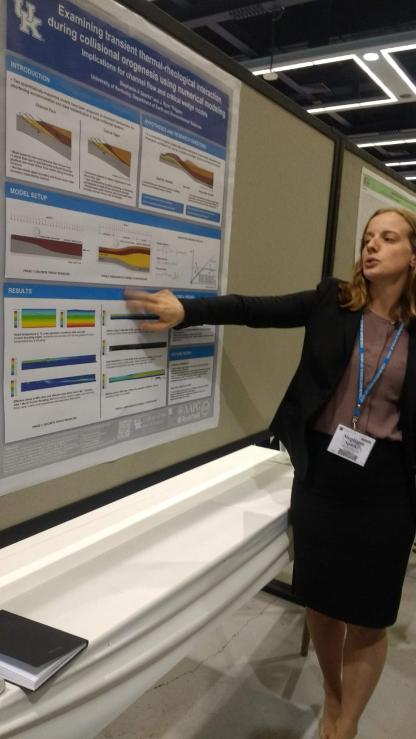
I did this in the form of a scientific poster. It is standard procedure at these meeting for geologists to gather in the conference center’s exhibit hall after the day’s formal technical oral presentations. Here, meeting attendees enjoy adult beverages and chat with other researchers about work that interests them. During my session, I met many geoscientists, from undergraduates with very little exposure to my particular field of study to some of the sub-discipline’s leading experts. Many engaged me in spirited discussion and some even posed questions for consideration that I hadn’t thought of myself. I learned quite a bit and was excited to share my project with the community at large.

IMG95201710259518032451095BURST00095COVER

Explaining my poster to conference attendees (photo courtesy of Edward Lo

In addition to presenting my own work, I was able to see what other researchers in my field are up to of late. Conferences are particularly useful for getting a more immediate idea of where scientists are heading with their projects since presentations don’t undergo quite as rigorous (and lengthy) review processes. I particularly enjoyed sessions dedicated to “Challenges in Tectonics”, which resulted from community input to a document meant to direct research funding. It was exciting to see how our discipline is evolving.

Meetings like this are also a great venue for building networks, visiting with colleagues from other institutions and even finding future collaborators. One of the more interesting networking events I attended was the On To the Future (OTF) Alumni Reception. OTF is program meant to increase diversity in the geosciences by providing funding for students to attend their first GSA Annual Meeting. During the reception, a very inspiring speech was given by the 2017 Bromley Award for Minorities winner, Aradhna Tripati. Dr. Tripati emphasized the importance of perseverance and encouraged audience members to speak more openly about challenges faced due to cultural and social inequalities that still exist within our institutions.

I was also fortunate to visit with several friends and colleagues with which I’ve developed relationships over the past few years. I was especially excited to have lunch with professors and a fellow student from the Border to Beltway program. This program was designed to introduce students traditionally underrepresented in the geosciences to the discipline and it was during this program I feel I really emerged as a geologist.

22729124_10154991726597286_3926727182757272881_n

Border to Beltway affiliates (photo from B2B Facebook page)

Overall, I had a really great time and I look forward to attending future events. If there is a meeting like this one for a topic that you find interesting I encourage you to attend!

20171026_162121

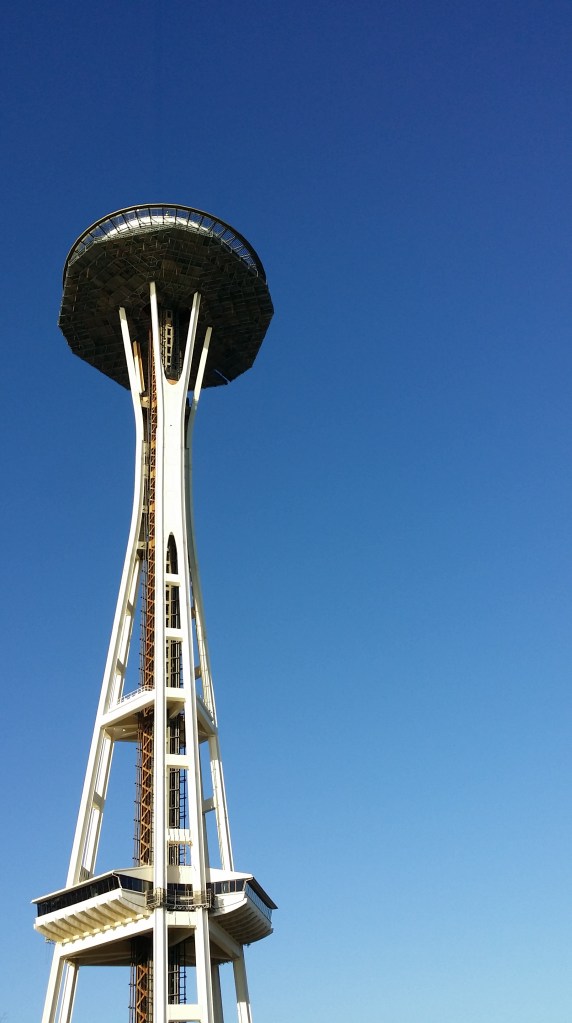
Partaking in some post-conference sight-seeing (Space Needle)