Checking In – From Rural Ohio

I live in Wooster, Ohio and I have been living here since August of last year. I’m finishing up my time here and reflecting on it some.

Just to update everyone: I finished my PhD in the Summer of 2025 and secured a position as Visiting Assistant Professor of Structural Geology and Tectonics at The College of Wooster in Wooster, Ohio. It is a very long title, but shorter than many of my colleagues, surprisingly. Wooster is a small liberal arts college in Northeast Ohio. It’s a teaching-focused institution known for its Independent Study requirement. Every student at The College of Wooster must complete a three-semester research project and develop a thesis prior to graduation. That’s kind of unique.

Well, I moved here knowing nothing about Ohio, and I don’t know much about the geology of Ohio even now to be honest. I’ve lived here a while and the theme that I can latch onto the strongest is that glaciers mattered. A lot.

Basically, during the Pleistocene – or pretty recently on the Geologic Time Scale – there was a cycle of warming and cooling of the Earth that during glacial periods, resulted in the formation of a large ice sheet (think Greenland but if it covered a heck of a lot more ground). Anyway, Ohio sees a lot of evidence of these glacial periods that occurred in the last several tens of thousands to a couple million of years, for example.
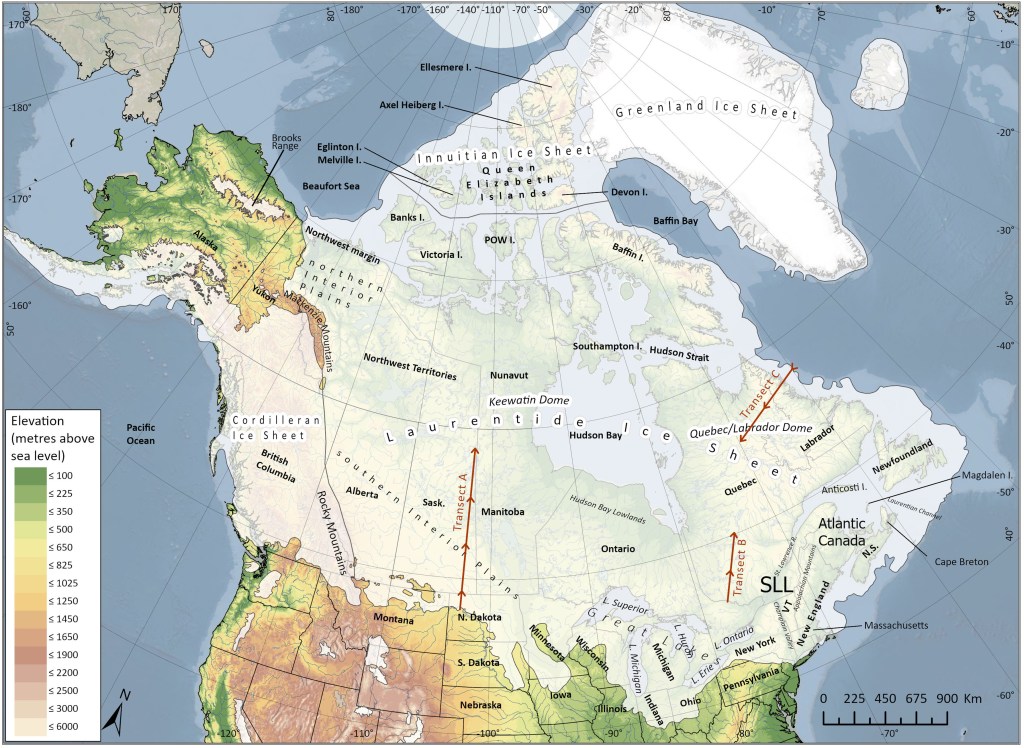
Extent of the Laurentide Ice Sheet during the Last Glacial Maximum. Source.

It’s particularly interesting when you consider how the landscape has evolved over vast geologic timelines. The rocks that underlie the great Buckeye State are around 400 million years old. These rocks record episodes of deposition, lithification, uplift, exposure, weathering, erosion, and transportation. Seemingly imperceptible, these processes – are on the one hand constructive and on the other destructive. But what’s even more interesting in my opinion is the way the landscape is so dynamically reorganized according to natural processes that play out daily. I guess what I mean by all of that is these rocks have seen some things.

There’s a rock type called diamictite. It’s a glacial deposit also known as “till”. Essentially the glacier indiscriminantly dumps all the sediment it’s holding onto so you get a wide distribution of sediment sizes, typically bimodal or two main size families (we typically classify sedimentary rocks based on the size of the pieces that make them up – in the case of diamictite this isn’t so easy!).

When I was a budding geologist, I was taking a class out in West Virginia and I had a thrilling discovery. I found a diamictite at a new locality for the first time. As a student. Who just learned the word diamictite. My mentor was so excited for me I couldn’t believe it. I thought to myself, “wow this guy cares a lot about rocks”.

Then, last semester, I got the opportunity to take my intro class out to the local park – Wooster Memorial Park. We stumbled across a diamictite. One of my students correctly identified it as such. We did a segment in class on Snowball Earth where we talked about glacial deposits and this brilliant first-year made the connection. Incredible. I suddenly understood what it meant to “care a lot about rocks”.

We also get glacial erratics. These are essentially rock expatriates. They started somewhere else and a glacier tore them out from their home, moved them great distances, and dropped them off to live somewhere else indefinitely. It reminds me of my move from Arizona to Ohio, honestly.

I’ve spent almost a year here. There has been a lot to love about Ohio – the local parks, The College of Wooster and all of my amazing colleagues that I’ve learned from and developed relationships with. I love Shreve Swamp (also known as Killbuck Marsh). Where I can scout for evidence of beavers and otters. I’m close to Cleveland and I’ve spent some time in that city, which I find lovely.

But, we really did it now – we finished our first year as a full-time faculty member. We learned a lot, we will continue to grow and we’re excited about the next thing – which includes a move back to my home state of Virginia!

But, I’d like to see the glacial grooves at Kelley’s Island before I move. I don’t know, something about glaciers allows me to connect deep time with human time scales. We don’t see them moving. We see the evidence instead.

The grooves carved into bedrock. The diamictites left behind. The erratics deposited far from home.

Maybe that’s what I find so compelling about them. They appear still, yet they transform entire landscapes.

I’ve only been in Ohio for a year. It doesn’t feel like a very long time.

And yet, the evidence is everywhere.

Under Pressure

Last month, I spent a few days in New England. There’s something extraordinary about Fall in a place with four seasons – shortly after I returned to central Arizona, it finally dropped below triple digits!

I flew into Boston and spent a night in Cambridge because I was visiting with a friend from my teenage years/early adulthood who has been living there for a while now. I remember Katrina always wanted to end up in Boston, and I’m happy for her now that she’s successfully built a life there. We spent the evening near the MIT campus, stopping for ice cream at Toscanini’s before dinner because, according to Katrina, “Bostonians love their ice cream and have been reported to consume more of it per capita (especially in winter) than any other place in the United States”. Katrina ordered the goat cheese, honey, and pecan variety, which sounded really good, so I followed her lead. Delicious!

We walked around Cambridge, and Katrina shared facts about the local architecture and pointed out details I wouldn’t have otherwise noted. We walked around looking for a place to eat and landed at an all-you-can-eat hot pot establishment. It was very good, and we were very full. The next day, we walked over the bridge from Cambridge, and I ended up working remotely from a coffee shop on the Berklee College of Music campus – Boston has its share of higher education institutions, no doubt!

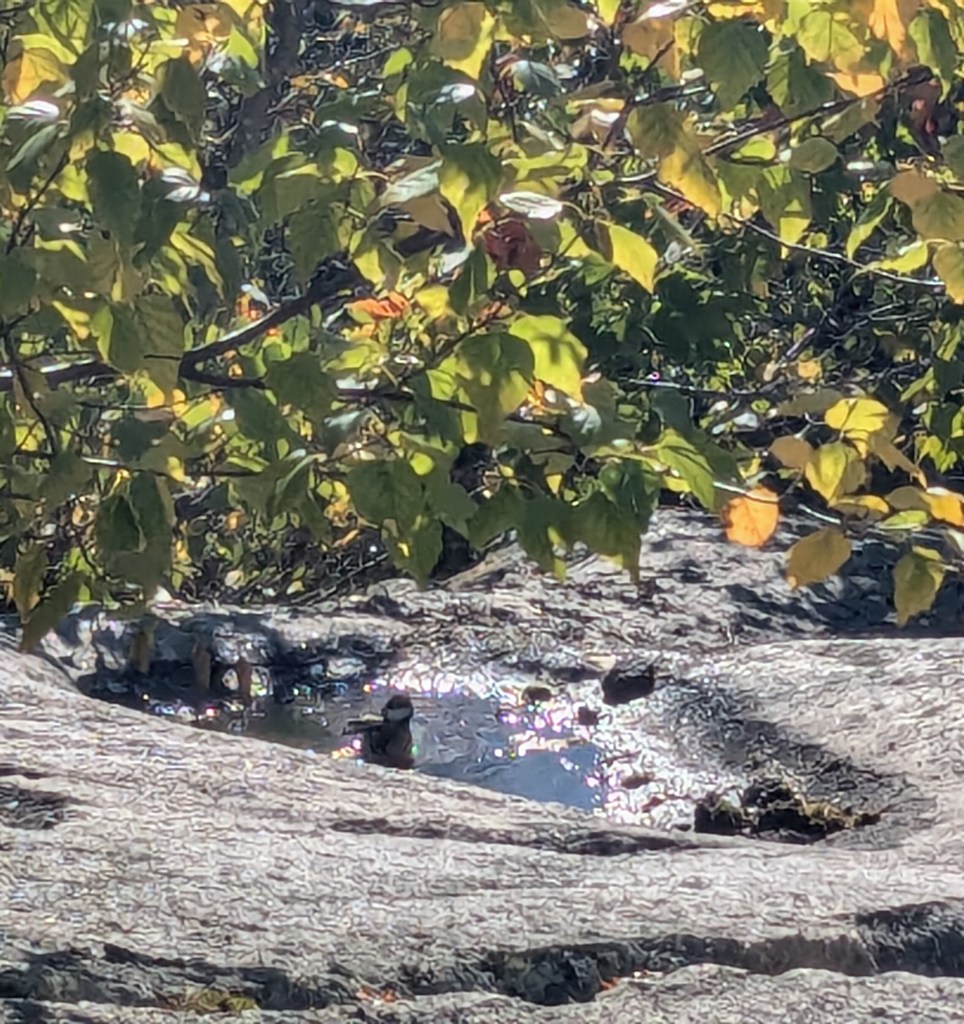
Some friends were joining me for the weekend in New Hampshire, the real purpose of the trip out East. We were to attend a rock climbing festival for women and genderqueer people called Flash Foxy Trad Fest in North Conway. We drove out to New Hampshire together and were to host a climbing meetup for the festival, but it had rained heavily the evening prior, and the rock was quite wet – too slippery for climbing on. Therefore, we decided to hike a short trail called Black Cap, and we saw a BLACK-CAPPED chickadee bathing in a puddle left from the previous night’s rain. 

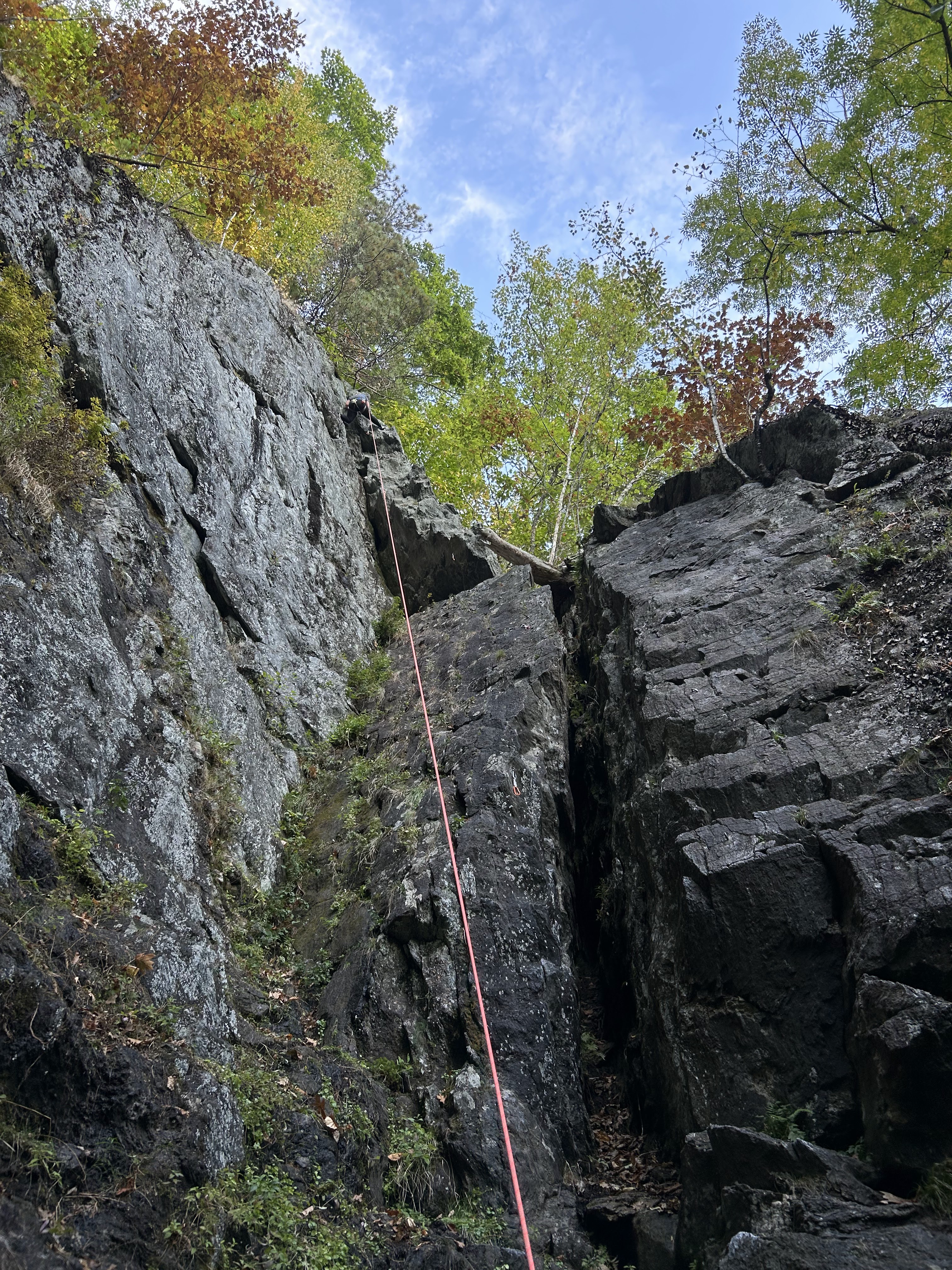
Our plan for the following day was to spend the day doing something called sport climbing (funny, because the festival is called “Trad Fest”, which is a different style of climbing). In sport climbing, a leader uses fixed hardware in the rock to run a rope up the wall and protect other “followers” who wish to climb the same route. Diedre was the leader for all of the routes we climbed that day – an amazing feat and a serious demonstration of skill and courage.

We did several easier routes that day and one more moderate route – not that climbing grades (which denote relative difficulty) are important, or even objective. The “easier” routes were actually a good level of difficulty for me but the “harder” route was a little to much for me in my current state. I decided to bail prior to completing it because I had already made it past the crux – or hardest part of the climb – and I was so exhausted both mentally and physically. I knew it’d be better for my general well being to be able to put myself on more horizontally oriented ground.

I took a much needed break, talked with my mother <3, and enjoyed a short nap. I returned to the crag and finished the climbing day with an easy – but really fun – route called “Shealyn’s Way”. It features a lot of different climbing styles and the route is relatively long for a single pitch (as far as one can go with a 60 meter long climbing rope). I felt all of the uncertainty that I had built up within me from the more difficult climb completely wash away.

The rock we were climbing is called schist. It’s a rock that has been “metamorphosed” under elevated temperatures and pressures which causes changes to it’s crystalline structure. The minerals in the rock orient themselves as a response to the stress that is applied to them and you end up with a rock that records this story of undergoing change under pressure. It’s like when you push down on a ball of play-dough and it flattens into a new shape in response to the applied force.

Metamorphic rocks have always been my favorite of the three rock types (igneous, metamorphic and sedimentary). I think it’s because these rocks record their history of undergoing stressful situations. These “situations” often involve great forces and large-scale dynamism that for me is awe-inspiring and exciting to attempt to comprehend. That storied history literally changes them and that’s what – in my opinion, anyway – makes them beautiful and interesting.

So when I have a tough time climbing a hard route or when I doubt my ability to accomplish hard things, I remember that personal challenges transform me into something also more beautiful and interesting.