Something Worth Saving

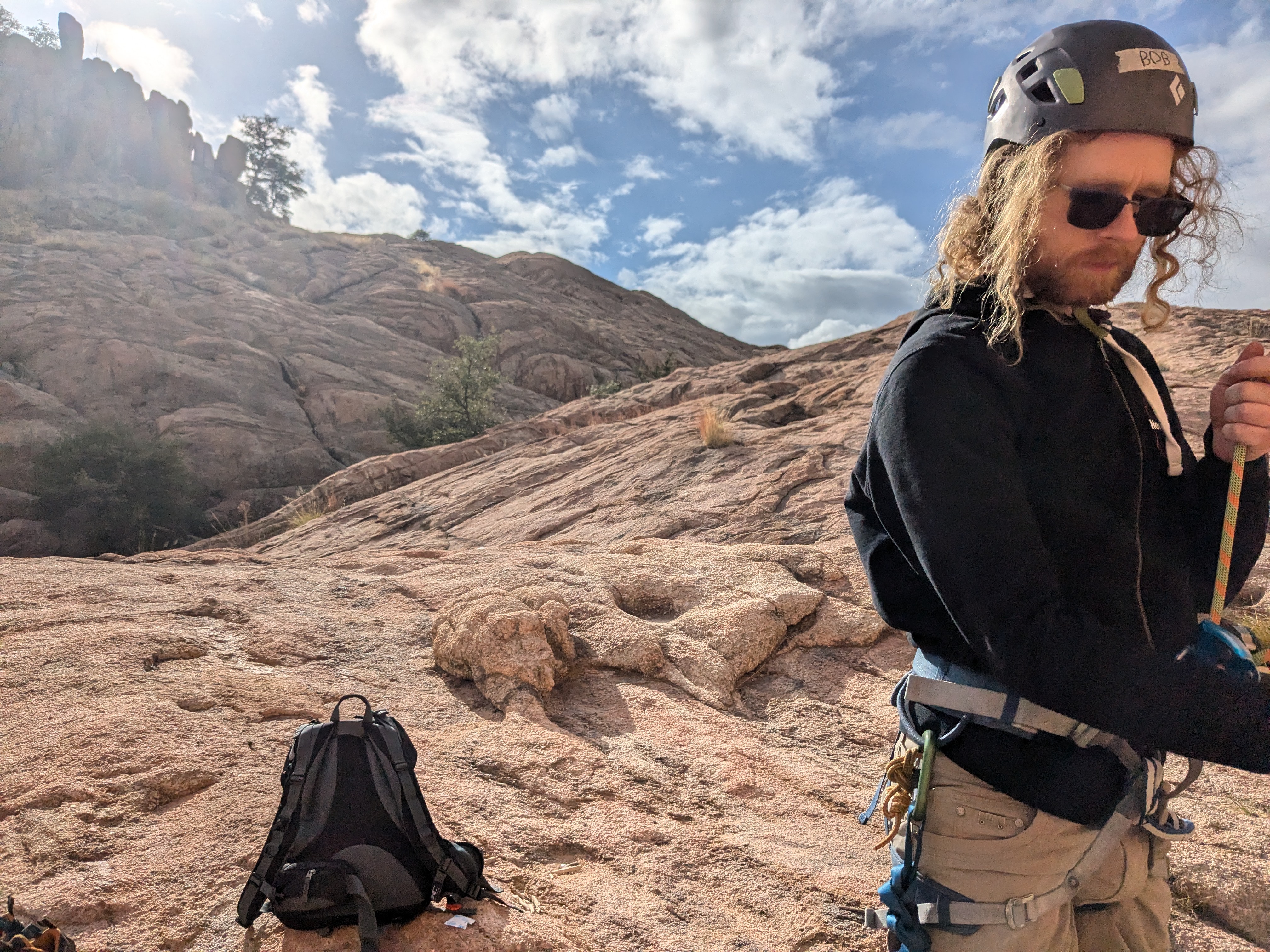
About a month ago, I traveled up north for the weekend to Prescott, Arizona, to do some mellow outdoor rock climbing and less mellow (below-freezing) camping with my partner Bob. I needed to be up there on Sunday because I was slated to volunteer with the Arizona Mountaineering Club for their outdoor school focused on building anchors. Anchors are meant to attach a climbing rope (or a climber) to a rock surface during rock climbing. The climbing rope is used as the climber’s lifeline, so learning how to ensure its safe placement and security is essential for climbing outdoors. 

A good climbing anchor follows the acronym ERNEST, which stands for Equalized, Redundant, No Extension, Solid and Timely. Equalized means all components of the anchor distribute the load equally, redundant means if one component fails there is a backup, no extension means there shouldn’t be any shock-loading at any point, solid means each component is strong enough to hold an impact on its own, and timely means it can be put together quickly if necessary.

I’ve volunteered as the Community Outreach Coordinator for a while with the Arizona Women’s Climbing Coalition, another local climbing organization. The organization aims to empower women and genderqueer people through rock climbing. My role is to help connect the organization and its members to different aspects of the rock climbing community, like other local climbing organizations, local businesses, and national non-profits and brands. One more recent example includes my efforts to join forces with the Arizona Mountaineering Club. We plan to partner on a stewardship project by providing funding and volunteers.

Earlier this year, we were preparing for an annual fundraising film festival, and I was contacting the owner of a local mountain guiding company for donations. Mac McCaleb runs Granite Mountain Guides, based in Prescott, Arizona, but also leads the local climbing organization Prescott Climbers Coalition (PCC). Mac generously donated to our cause, and through our interactions, I learned about the PCC’s role in protecting an area outside of Prescott that has many uses – including recreational rock climbing and climbing instruction. 

The campaign is called SaveSullivans and refers to Upper Sullivan’s Canyon, a significant land area because it is where the Verde River begins, right below the dam at Sullivan Lake. The Verde River is a tributary of the Salt River (which I wrote about here), and a portion of its 170 or so miles is protected through the National Wild and Scenic River program.

In the vicinity of Upper Sullivan’s Canyon, the area is designated as the Upper Verde River Conservation Opportunity Area (COA), by the Arizona Wildlife Conservation Strategy. The COA is a known Important Bird Area (IBA), comprising nearly 2000 acres of quality riparian habitat.

The land is also popular for outdoor recreation activities, including wildlife viewing, hiking, and – of course – rock climbing. My personal experience with rock climbing at Sullivan’s mainly includes its use as a natural “classroom” for rock climbing technique instruction through the Arizona Mountaineering Club (AMC). I have been involved with three courses there, once as a student and twice as an instructor, but the AMC has been using Sullivan’s to teach skills critical to the safe enjoyment of rock climbing in Arizona (and beyond) for decades. My last experience with the AMC occurred just one week following the celebration of the organization’s 60th “birthday.”

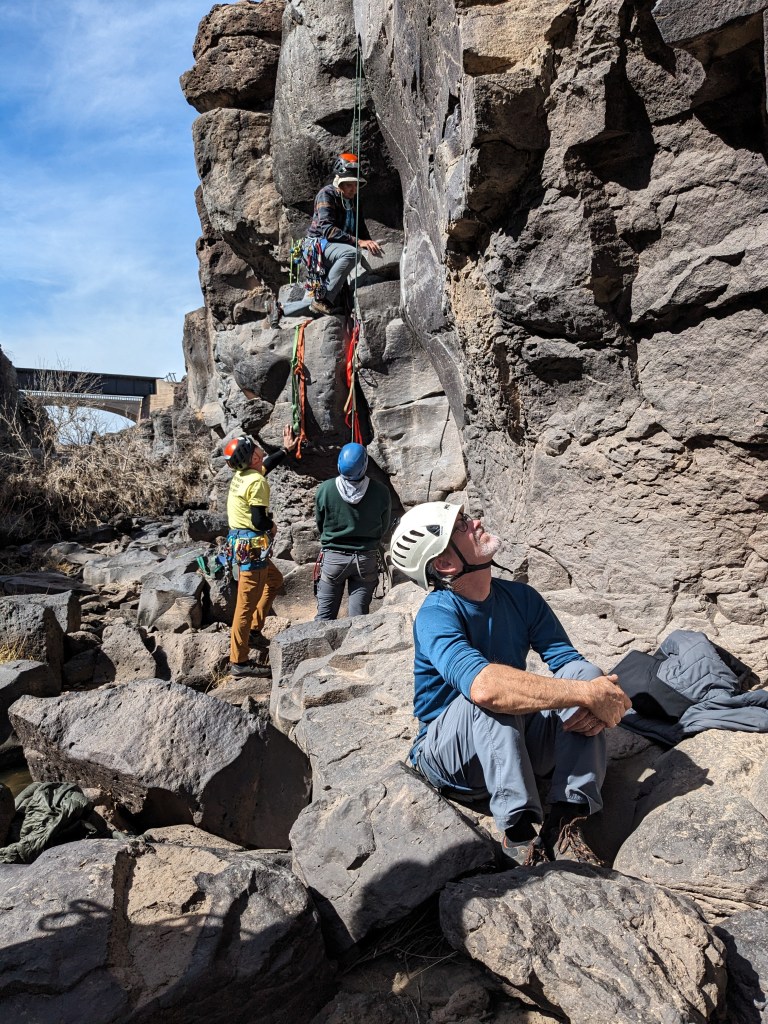
I’ve also tried climbing there – although the routes I attempted were quite tricky. The rock is something to be admired: it’s basalt, an extrusive igneous rock that is relatively young here – dated at only about 4.6 million years old! It is known as the Perkinsville Formation in this area. It consists of basalt flows from volcanic activity that followed the uplift of the Colorado Plateau – when deeply sourced material from a hot, upwelling mantle traveled upward through the crust, melting it and elevating it.


The physiographic region where Upper Sullivan’s Canyon is located is known as the “Transition Zone,” it denotes the boundary between the Colorado Plateau and the Basin and Range provinces. Therefore, geomorphic characteristics of both provinces are on display here, and the younger basaltic volcanism present in the area is likely due to late-stage, large-scale crustal extension associated with the formation of the Basin and Range. Much of the American Southwest was stretched about 12-8 million years ago, and subsequently faulted at a high angle, resulting in down-dropping basins filled with sediment adjacent to uplifted blocks forming the ranges.

What followed was a period that one of my colleagues likes to refer to as “Life After Faulting.” Landforms developed across the region as surface geomorphological features, like the Verde River, shaped the landscape. The section of the river that includes Upper Sullivan’s Canyon is a channel constricted by steep canyon walls due to the Verde River chewing downward into the uplifted landscape more recently (~2.5 million years ago).

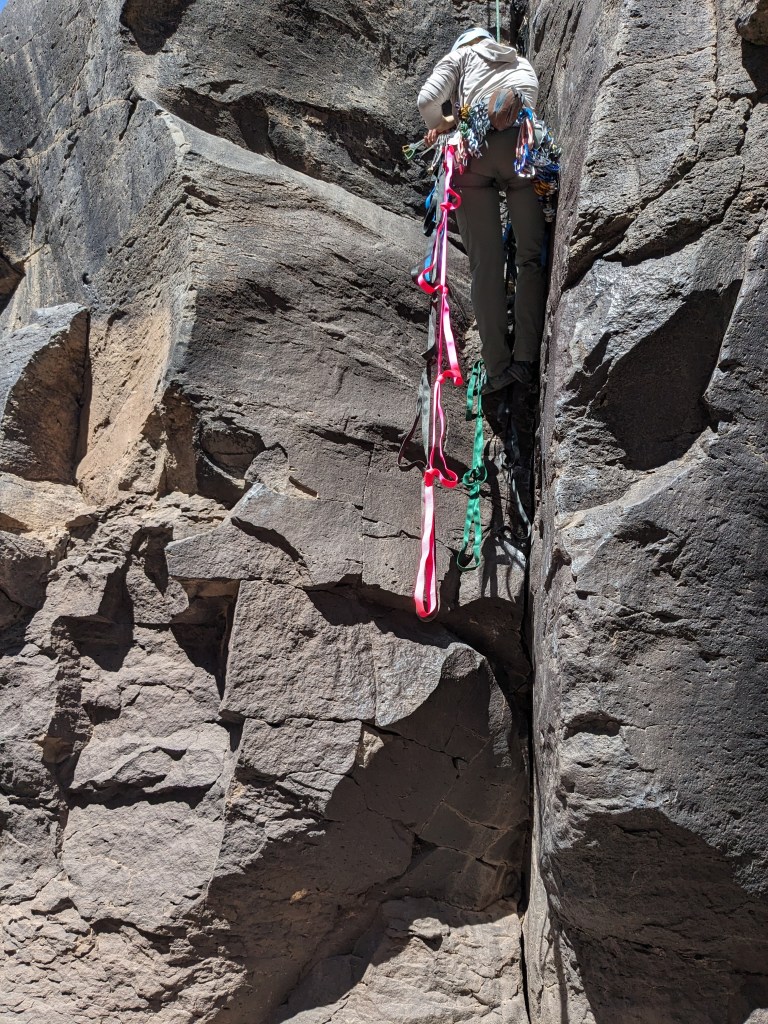
Exposure of these basalt cliffs has led to the area’s popularity for rock climbing today. Still, ancient features like columnar jointing in the rocks (see featured image, image above, and image to the right), make that climbing experience inherently more interesting. This distinctive pattern of vertical hexagonal prisms is due to contraction during the cooling of the lava flows. Another distinctive feature is its vesicular texture, a “swiss cheese” pattern of void spaces that form due to gases escaping from solution in the lavas when it erupted. The bubbles never got the chance to pop before the lava solidified, trapping these little gas pockets for us to observe millions of years later.
The geology of the Upper Verde River in and around Upper Sullivan’s Canyon has been found to impact the diversity of regional flora. Distinct species of plants correspond to different rock types. Of course, flora – in turn – impact the faunal diversity of the area, which includes “strategy species” of amphibians, birds, mammals, reptiles, and fish. One of my most pleasant experiences at Sullivan’s Canyon was observing a pair of majestic barn owls that seemed to be looking for a meal, perhaps rodents that indeed feed on the diverse vegetation there.

Beyond the ecological significance of Sullivan’s Canyon as a critical natural resource is its cultural and historical importance. Humans have found refuge here for a long time – as evidenced by petroglyphs and historical agricultural structures, including a few barns and a bunkhouse. I’ve only seen pictures of the petroglyphs, but I hope to learn more about them and find them on my next visit.
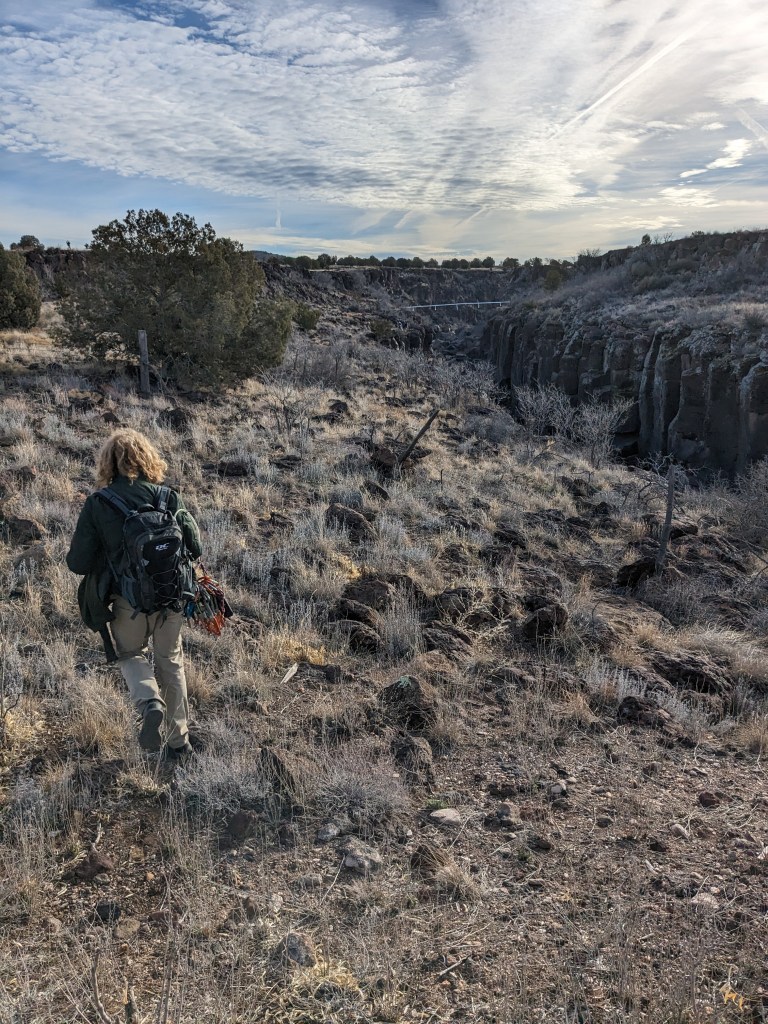


The SaveSullivans campaign is a worthy one. To preserve this critical natural resource – the “Gateway to the Upper Verde River” – is to ensure a flourishing ecosystem and secure the area for future generations. It is a place that combines the liberating power of nature and an intentional practice of keeping users educated and informed.

Donate here

Geology Mixtape

I’m old enough to have some experience (mostly during my early teenage years) making actual mixtapes… and as wild as it seems to me, you may not even know what that means, so I will go ahead and explain just in case.

Basically music portability used to occur via cassette tapes that consist of a magnetic tape that serves as an analog means of recording and playing back audio. The tape is wound around one spool and as it is read by the playback device the tape is collected on a second spool. I remember sometimes the tape would get pulled out of the plastic (or metal sometimes) cover and I’d have to use my pointer finger or the eraser end of wooden pencil to wind the tape back in – fun stuff!

Anyway, I would enjoy recording my favorite songs from the radio onto my cassette tapes so I could play them back when I pleased. I also curated different songs for themed “mixtapes” which I could gift to my friends and loved ones to share songs that I thought went well together. We now have digital playlists (on Spotify or whatever service you prefer) – which is pretty much the modern-day equivalent.

This process of arranging things – or organizing items into categories for a general purpose is something I’ve learned I excel at – I’m currently job-hunting so I recently took this assessment where you can discover your top strengths. One of mine is the “Arranger” which is described to me as “You can organize, but your flexibility complements this ability. You like to determine how all of the pieces and resources can be arranged for maximum productivity.” I think this trait transfers well to the creative realm and I started building my very own geology-themed musical playlist and I wanted to share that here.

In my opinion, it does not suffice to have a collection of songs just about rocks or geology or similar topics. In building my playlist I was looking for a specific “vibe”. I have to reach somewhat to try and describe it. Perhaps soothing or lightly upbeat sounds with some melancholy undertones. Maybe subtle notes with post-rock influences. Preferably performed by indie artists.

My motivation for this is inherently personal, as any good playlist typically is. Through the aging process, I’ve noticed a transition to a more relaxed state of being, and I think my musical taste reflects that. I also feel *lightly* upbeat a lot of the time (but not too upbeat; maybe merely content) and sometimes sad but pensive – not in a bad way though.

Stephanie’s Geology Mixtape

Drift – Galimatias and Alina Baraz

I chose this song because of the title – Drift. Continental drift was a concept that the early geological pioneer Alfred Wegener used to describe the motion of continental masses over long periods of time. The concept of continental drift was pivotal in the early development of plate tectonics theory. The song is about a feeling of passivity – specifically in a romantic way – but, it can be interpreted to represent loss of control.

Go Outside – Cults

I interpret this song to be about being held back by a loved one who is unwilling to experience growth. But, it’s called “Go Outside” and geologists spend a lot of time outside. I also think a big part of my pursuit of geology in the first place involved “go[ing] outside” of my comfort zone.

Through Me (The Flood) – Hozier

A flood is obviously a natural event that geologists care a lot about. It occurs when the capacity of body of water is exceeded – it results in what is typically dry land being inundated by water. In modern society, floods can be damaging and catastrophic. Hozier wrote this song during the COVID-19 pandemic when the world was being flooded with grief and loss; but, he also remarks on the strength of individuals to make their way through it.

After The Earthquake – Alvvays

This song describes a couple in a post-catastrophe scenario – they were arguing when one of them was suddenly injured in a car crash, putting the disagreement on hold. I often relate to how different experiences and events mold one’s perspective on things, especially life’s trials.

Alaska – Maggie Rogers

Alaska is just a place geographically, but – although it’s maybe a stretch – Alaska happens to be very geologically active. I like the song and add it to the list because Maggie Rogers sings about her reawakening following a difficult breakup. It reminds me how you can feel stuck in a difficult situation but then later experience something that makes you feel free again and perhaps even better than before.

SUPERBLOOM – MisterWives

More of an environmental science (or botanical) phenomenon, a superbloom occurs when an unusually high number of desert wildflowers blossom simultaneously, usually after heavy rainfall. This song resonates with me for several reasons, but I will suffice it to say that I currently live in the desert of Arizona, and leading up to that involved a lot of challenging experiences.

Meteorite – Anna Of The North

A meteorite is basically a space rock that “hits the ground alright” (it rhymes so its a good way to remember the difference between a meteorite and something that enters the atmosphere but burns up or otherwise doesn’t make it to the ground). This song is about a seemingly small encounter that has a large impact (pun definitely intended). It reminds me of times when I intentionally made small, manageable changes that later led to bigger, more meaningful ones.

Superposition – Young The Giant

Superposition is a concept that students typically learn about in introductory geology as “in undeformed columns of rock, the oldest is at the bottom and the youngest is at the top”. Its a concept of relative dating – or figuring out how old things are by comparing them to each other. I call it the “pancake concept” because when you make pancakes, you usually end up with the first one on the bottom and they pile up until last one ends up on top. The song is described by the artist to signify how in a realm of endless possibilities, one (superposed) outcome occurs.

Lava – Still Woozy

Lava is molten rock that has reached the planet’s surface. The song is about what I call a “volcanic” love. The artist describes his loved one in a way that renders high energy and explosivity – like a volcano. I know I can be a little hot-headed occasionally, so I hope that at least one person finds that endearing.

Landslide – Fleetwood Mac

This one is a classic, indeed. It encapsulates the concept of sudden catastrophic change – how everything a person has built in their life up to a point can all come crashing down, like a landslide. I went through a significant and tumultuous transformation midway through my doctoral studies, and during my healing process, I heard this song, which holds extraordinary meaning for me.

Connecting the seemingly unconnected

About a year ago, my grandmother was on her death bed and some of my family got together at my uncle’s house in San Diego, CA, where my grandmother had been living since my grandfather passed away. During this somber time, my cousins and I found solace in thumbing through my grandmother’s photo albums that she created over the years of her life. Within them we found letters, postcards, brochures and tickets from her and my grandfather’s travel, and – of course – photos of all of us as small children. It was bittersweet: the photos captured found memories of our youth, but we also reflected on the loss of innocence that occurs with age.

I realized that there was something about holding the albums full of photos and various artifacts lost in today’s digital world. I decided I wanted to follow after my grandmother and start scrapbooking my life’s events, a sort of “analog” version of social media that has become such an integral part of most of our lives.

Taking things back in this way has helped me realize some things, like how I have a certain type of creativity that I don’t always get to explore – by making something just for the sake of making it – or how one terrible photo can jog a memory of a significant event just as well as (if not better than) ten beautiful ones. I find it as a way to do something useful with all of the personal artifacts I’ve been collecting over the years and in turn, reduce my clutter. I’ve also lovingly shared stories and memories with friends and family as they look through my creations.

Anyway, last weekend I was scrapbooking a trip to Europe I took last summer and I thought I’d write about it here.

In Late August 2022, I attended a workshop in Hévíz, Hungary called the Ada Lovelace Workshop on Modeling Mantle and Lithosphere Dynamics. The meeting’s namesake, Ada Lovelace, is commonly credited with being the first computer scientist because she recognized the potential for mechanical analytical machines beyond pure calculation and was to come up with what would later be considered the first computer program.

The Workshop, named in honor of Lovelace in 2020, is held every two years in different locations throughout Europe and last year it was held in the town of Hévíz, Hungary. This location is known for thermal Lake Hévíz – the second largest “thermal lake” in the world and the largest one with temperatures suitable for swimming.

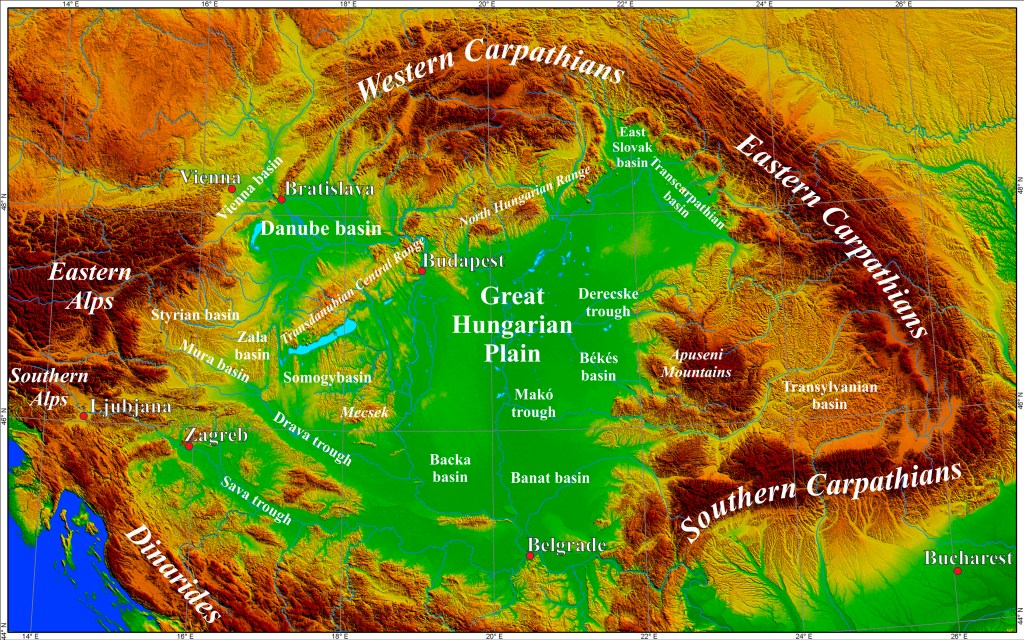
What makes Lake Hévíz a thermal lake? Hungary is situated in an area known as the Pannonian Basin. This basin resulted after smaller continental fragments collided with the European continent. Starting at about 17.5 million years ago and continuing for about 10 million years – during the middle-to-late Miocene – basins formed behind the Carpathian Mountains as the continental crust extended up to 100 km in an East-West direction. The depth of this extension varied with distance from the Carpathian Mountain range.

Digital terrain model of the Pannonian Basin and surrounding area [source].

Researchers posit that southward (and eastward) migration of the extensional zone occurred and the most internally situated portions of the basin were associated with the greatest depths. That is, the inner basin formed from extension of the entire lithosphere (the crust and uppermost mantle)!

Image Source

When the lithosphere extends in this way, it is thinned out and the deeper, hotter mantle “domes” and becomes situated closer to the surface. Even stranger is that lithosphere of the Pannonian Basin is about two times hotter than would be expected from these types of extensional processes alone. The paper cited attributes this extra thermal energy to “unknown processes in the lower lithosphere”. A more recent paper suggests that the higher modern temperatures are due to the fact that sediments that subsequently filled the basin are good insulators of the hot rocks at the base of the basin. In other words, cooling due to exposure at the surface has been significantly slowed. This has resulted in geothermal gradients (increases in temperature with depth) of up to 50°C/km in the uppermost 5 km of the crust. That’s about two times the global average.

What I found most interesting while looking up the geology of the Pannonian Basin was the tectonics that resulted in its formation. The tectonics of this area is related to the overall mountain building period associated with the formation of the Alps: The Alpine Orogeny. The Alpine Orogeny is linked to the Himalayan-Tibetan Orogeny (the mountain building period resulting in the formation of the Himalayan Mountains and the Tibetan Plateau). They are associated because they began around the same time and resulted in the closure of an ancient ocean known as the Tethys Ocean. Further, there are similarities in the respect that there are large-scale extensional features that form in a dominantly convergent setting. The discovery of this for the Himalayan system was groundbreaking, and actually involved my PhD dissertation advisor.

I think that has influenced what I find interesting and important when learning about the geology of new places. I often link what I find to what I’ve become most familiar with during my studies. I’ve written it before here, but I’ll say it again: “the best geologist is the one who has seen the most rocks”. Because I think it’s human nature to relate what one has experienced in the past to what one is experiencing for the first time.

The power to connect the seemingly unconnected.

William Plomer

The writer William Plomer described creativity as “the power to connect the seemingly unconnected.” If it is in fact very human to relate past experiences to new ones, everyone is creative and whether it be scrapbooking a trip I took almost a year ago, learning about the geology of a new place and connecting it to something I’ve spent years learning about, looking at spreadsheets full of model-derived data trying to see if any patterns develop, or even writing this blog: I get to be creative every single day.

Creativity is exactly what science is to me. As I learn more about geology, I learn more about the ways in which different physical systems that contribute to shaping our planet depend on each other, in sometimes unexpected ways. As part of my dissertation research, I’m seeking to learn how to determine the specific ways a single parameter, for example, effects how we interpret an entire complex model of the earth. In essence, I’m trying to disentangle a web of interdependent physical parameters and processes and in doing so, understand how they all fit together in the first place. By Plomer’s definition then, my science is nothing other than an act of creativity.