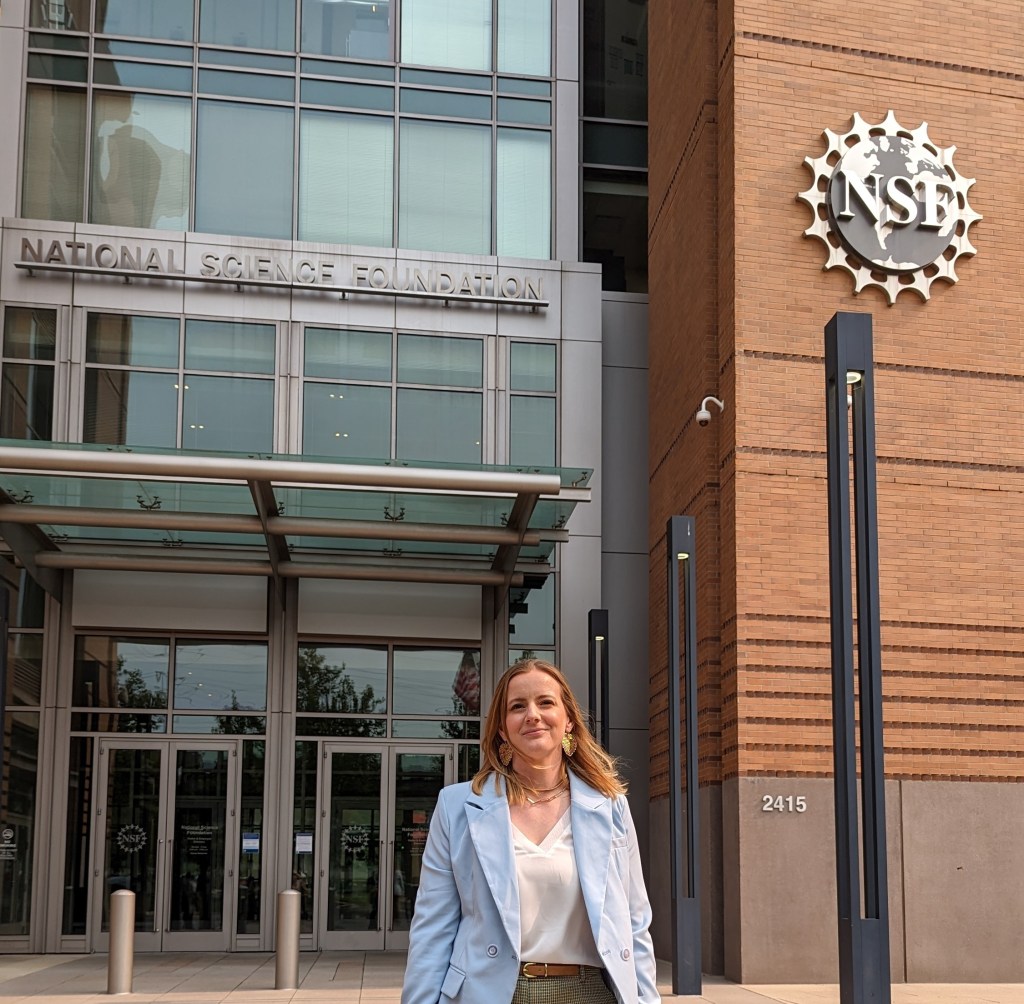
Last week, I participated in a workshop called Science Outside the Laboratory in Washington, DC. The program brings graduate students pursuing PhDs in science and engineering to Washington, DC to learn about all things related to science policy. Over the course of the week, we met with people from academia, government, industry, and other sectors involved in science policy. Some examples of the types of people we met include individuals working for government agencies like the EPA and the Department of Energy, Senate staffers, museum curators, diplomats, and journalists.
The program was enriching and engaging, and I truly enjoyed my experience. For example, as a former public servant working in international science and technology policy, I had experienced interfacing with a lot of the types of people we met during the workshop; however, I also met with folks in positions I had never before thought of as having an impact on science policy. This experience opened my eyes to new possibilities of career choices for PhD scientists outside of academia.
On the first day of the workshop, we were primed in introductions. We were slated to meet a lot of very smart, very important people and needed to know how to introduce ourselves and what we do in a way that is efficient and informative. We performed an exercise where we explained to another participant who we are and what we did and then received feedback. We then had to cut our introduction shorter and shorter over the course of a few iterations of the exercise. Lastly, we were told to not only explain what we did (for our research, that is) but why it mattered. This last part is particularly difficult for me but probably the most important, especially in a science policy-focused setting.
My issue is I feel like the work that I do, while important and interesting to me, has little appeal to those not as intimately connected to it. I know that my research matters in a larger context but most of the time, I feel like my day-to-day activities have little to do with things that my research could impact further down the line.
When I’m asked why my research matters, I typically make connections between understanding plate tectonics, mountain building, and fault development and evolution. This is important because faults are breaks in the earth’s crust upon which motion occurs and associated with motion along faults are earthquakes. In fact, a lot of my research uses data and models associated with the Himalayan mountain range. This region is prone to large, destructive earthquakes due to the tectonic setting of the area and the development of the Himalayan mountain system. Further, although it may not seem obvious, there are interdependencies between the development of the Himalayas and the climate of that area.
So, I’m not completely at a loss when it comes to relating my research to “things that matter”. The problem is I almost feel inauthentic when making these connections. The reason for this, I think, is that it is difficult for me to realize that running one (or even several) models of deforming crust could save a person’s life in an earthquake or monsoon prone area.
I suppose that this is more of an existential problem in that I’m challenged in relating what I see as a minor contribution (my own work) to something that is truly transformative for society.
But that doesn’t mean that it is a waste of time. And although I have to remind myself of it sometimes, the work I do is important in tackling the societal problems mentioned previously. Scientific progress as a whole can be very incremental in nature and it can take a long time to really appreciate how one scientist, or one PhD project really results in a significant contribution.
My difficultly in grasping this has partially led to my interest in science policy in the first place. I feel that it’s easy for me to lose the connections that make my work worthwhile (other than my personal genuine interest in the topics I study). But science policy seems to me an opportunity to use the skills I am gaining as a PhD researcher to make a more immediate (and perhaps more direct) impact on society.
 OROGENY ODYSSEY