This week marks the five-year anniversary of me moving to Arizona from Kentucky. I can’t believe it has been that long, it certainly hasn’t felt like it. But if I reflect back on what my life was like 5 years ago, versus what my life is like today – it couldn’t be more different. Not just the surficial things (different home, different partner, a second cat) but also the way I handle things in my life (better relationships with the people in my life and improved mental and physical health). I’m proud of who Arizona has turned me into and I’m truly happy with the transformation. Many days I think about how good things are and think they just couldn’t get any better, and then as time goes on things do just keep getting better and it blows my mind.
On my way out to Arizona though, I stopped in a lot of places and did some geologizing. I documented my experiences with the intention of one day writing about them in this blog. Well, I guess five years later, here we are…
The first place I stopped was the National Corvette Museum in Bowling Green, Kentucky. You might be thinking what does that have to do with geology? It turns out, in 2014, the National Corvette Museum was partially destroyed by a sinkhole which opened under the floor of the Skydome area of the museum. As a result, 8 Corvettes fell into the sinkhole along with the collapsed portion of the building.

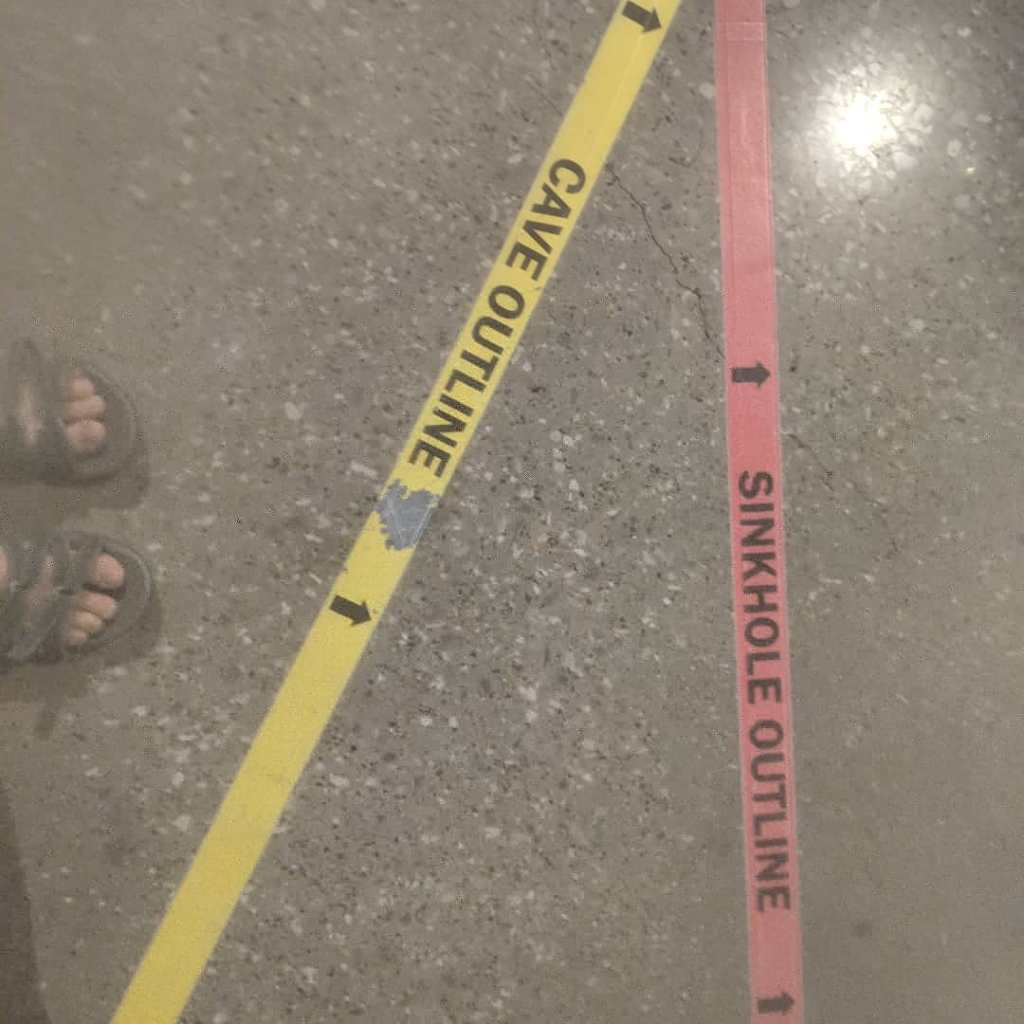
In case you didn’t know, there’s A LOT of limestone in Kentucky (it contributes to many things about Kentucky like the quality of the bourbon, making it an ideal place to raise horses, and the bluegrass itself). Limestone is a rock composed primarily of calcium carbonate, which dissolves in groundwater. This results in void spaces underground that grow and grow until the space gets so large that there’s not enough support for the land above the spaces and the surface of the land collapses.
The primary bedrock formation on which the Corvette Museum was built is known as the Ste. Genevieve Limestone (sometimes combined with the St. Louis Limestone). That first link is to the geologic map copied below. You can see that most of the map is colored blue, which the key tells us is the Upper Mississippian Ste. Genevieve Limestone. The Upper Mississippian (Visian) spanned from about 350 to 330 million years ago.

During this time, much of North America, including present-day Kentucky, was under water. It was also south of the equator. The conditions were favorable for the deposition of carbonate rocks like the limestone members mentioned previously. That is, in shallow marine environments relatively close to the equator. These limestones contain fossils, including rugose corals in the St. Louis member. Rugose corals (sometimes called “horn corals”) are extinct today but were common from about 460 million years ago until the end of the Permian (about 250 million years ago) when the largest mass extinction in Earth’s history occurred.
So, whether you stop by the National Corvette Museum for the cars or for the karst (landscape underlain by limestone), there will be something interesting to see!
 OROGENY ODYSSEY