Mourning, or something else?
I was sitting across from some colleagues in a hotel dining hall in Czechia when I said it: I was “mourning the death of my research career.”
I travelled a lot this past year. I was on the job market, interviewing and attending professional events to connect with scientists working on similar or complementary research problems. One of those trips took me to the 2026 Ada Lovelace Workshop on Modelling Mantle and Lithosphere Dynamics. Over dinner, I was announcing my new position, the one I’m in now, to my colleagues. In doing so, I was also letting the researcher I’d talked with earlier in the year about a postdoc know that I was no longer available.
I didn’t say it because I was ungrateful for my new position. It’s actually quite the opposite. But I was going from a research-intensive role to a teaching-intensive one, and that was quite the transition in itself.
I’ve been at NOVA since August, and a lot has happened in a short time. I’ve been developing courses, thinking about how to meet learning objectives, coming up with creative ways to engage students, and learning the ins and outs of a new institution.
A couple of weeks ago, though, was a good week. Not just a busy one: I felt good pretty much the whole way through. I had a class observation, a couple of really good teaching days, and it all culminated in the 2026 Virginia Geological Field Conference.
I brought back only one rock from the field conference, and this post is dedicated to it. I didn’t even collect it myself. More on that in a minute.
A shiny, flattened rock
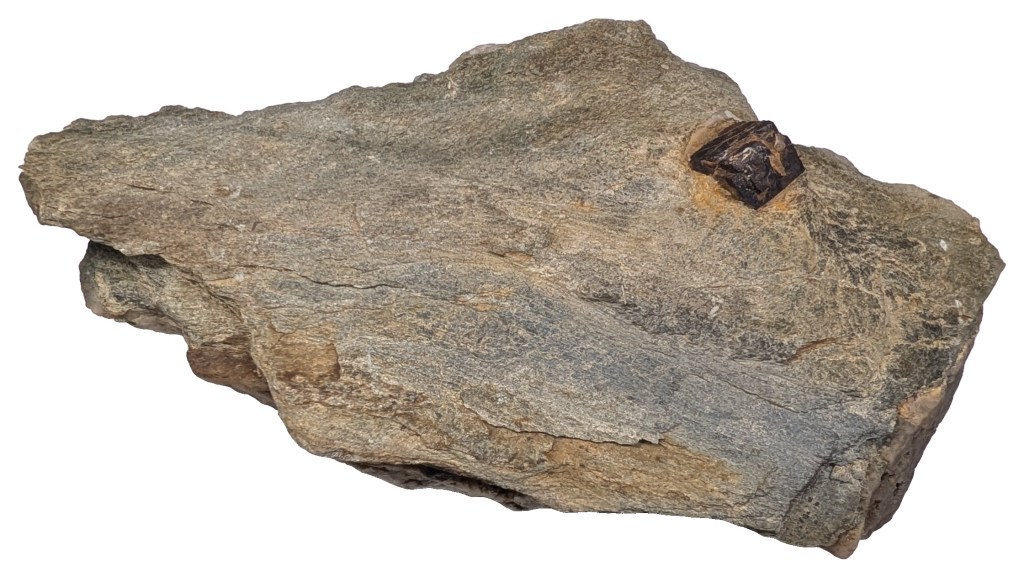
It’s a metamorphic rock called phyllite. The funny thing about phyllite is that I’ve never settled on a consistent way to pronounce it. I learned FILL-it, but I think it’s FILL-ite, and I go back and forth between the two. (Dictionaries side with FILL-ite. I still slip.) The name comes from the Greek phyllon, “leaf,” for the way it splits into thin, silky sheets
I grew up in Northern Virginia, and I became interested in geology here a little over 10 years ago. I remember hiking the trails near my apartment and seeing this shiny, flattened rock everywhere, then learning that it’s a metamorphic rock. That means it started out as a different rock, in this case mud on an ancient seafloor that hardened into shale, and was later recrystallized by high temperatures and pressures.
That recrystallization is what makes phyllite shiny. As the rock is heated and squeezed, tiny flakes of mica grow in it. Under differential stress from Appalachian mountain building, those flat flakes line up perpendicular to the squeeze, like a scattered deck of cards pressed flat under a book. All those aligned flakes catch the light together, which gives phyllite its sheen. Geologists call that layering foliation, and its orientation tells us which way the rocks were squeezed.
The phyllite I brought home last weekend is a little more interesting than the rocks I got to know on those trails. It was collected in a small stream valley outside of LOTUS at Yogaville. Let’s unpack that for a second.
The outcrop I (mostly) missed
The Light of Truth Universal Shrine, or LOTUS, is an interfaith temple at Yogaville in Buckingham County, Virginia. We stopped there for a short break, but there was an outcrop too. Another geologist and I had lingered behind the group for a minute and were hurrying to catch up.
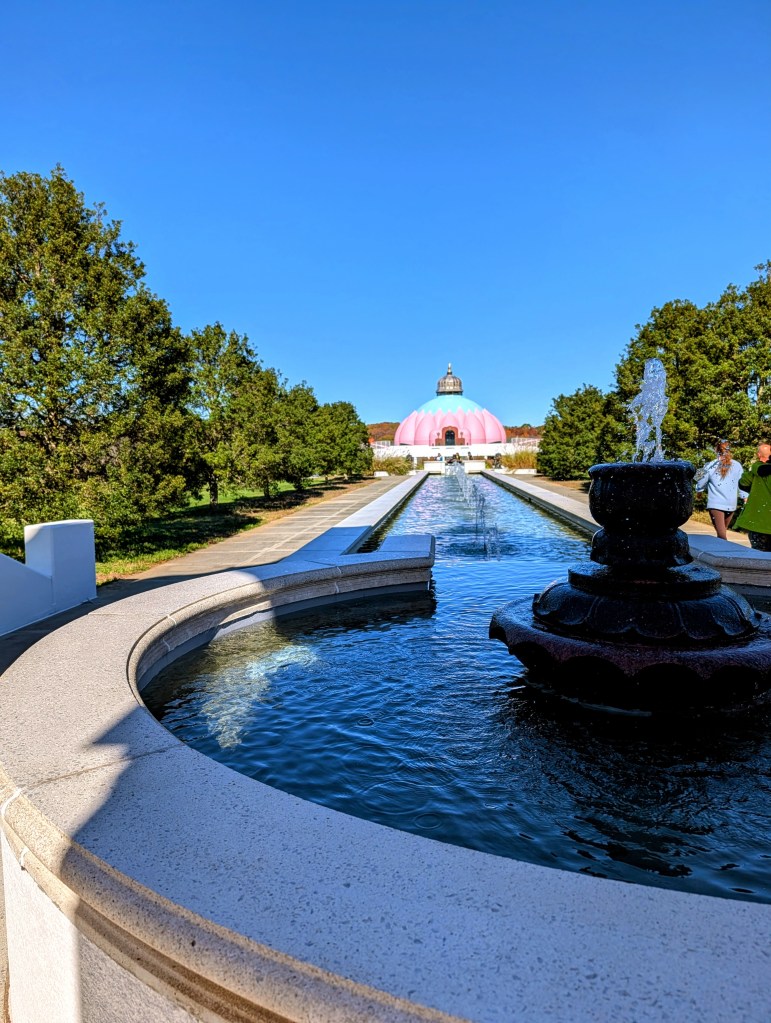
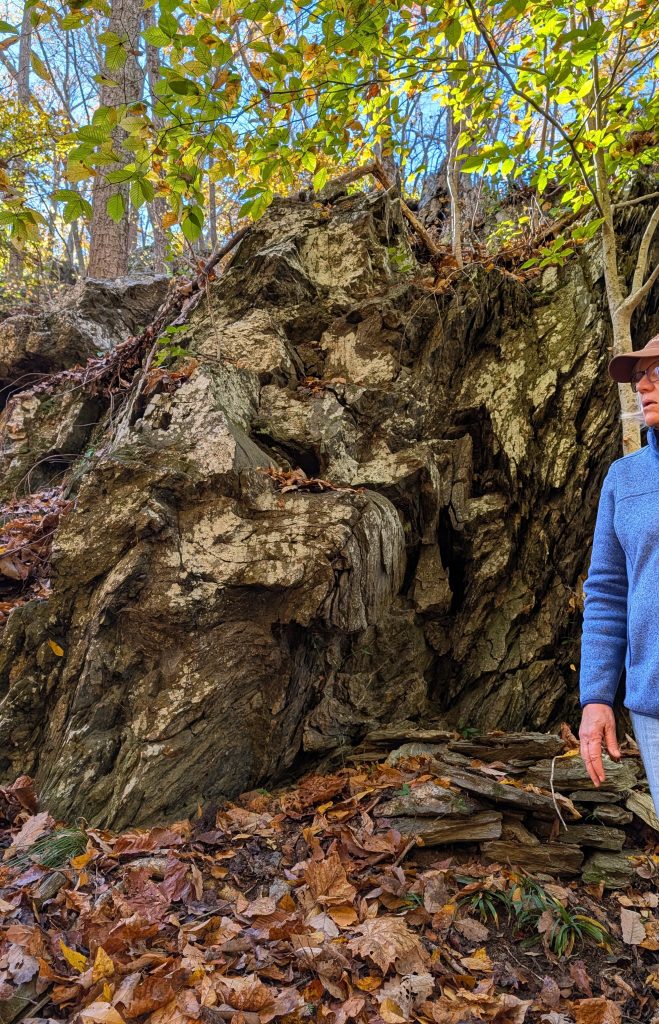
It was a perfect fall day, with clear skies and about 70°F, but the trees kept the outcrop in shade. It sat near a small pond on the temple’s property, where a stream had cut down to bedrock made of impressively folded layers. The same Appalachian squeeze that lined up the micas had crumpled these rocks like a rug.
To get there, I had to jump to a large rock in the stream. I wasn’t sure I’d land it, but I made it across, only to find the ground beneath the outcrop steep and precarious. Looking upstream, geologists in high-visibility vests speckled the outcrop, bright orange and yellow against the green of the vegetation and lichen.
That scene brought me back to my own Appalachian geology years ago, when I was first taking field classes in geology. I later ended up at the University of Kentucky and ended up doing more field classes in the southern Appalachians. There is an art to reading these rocks. In the Appalachians, outcrops are scarce, weathered, and hidden under soil, trees, and lichen, so you piece the story together from scattered exposures. Out West, where I did my PhD, the rocks are bare, and you can trace a single fold across an entire canyon wall.
I looked over the folds, but I wasn’t confident in my footing, and I’d already missed the introduction and most of the discussion. So I walked back to more stable ground with a few others.
Luckily, the next morning we met for a hike down to the James River along what are interpreted as old river terraces. Before we headed out, the field trip leader, Chuck Bailey, showed us a sample he’d collected from that outcrop near LOTUS and asked if anyone wanted it. My first thought was that it would be perfect for my teaching collection, so I asked for it.
Reading the rock
This rock has a long history. It’s interpreted as part of the Evington Group, in an area geologists call the Buckmarlson Transition Zone (Spears et al., 2015). Buckmarlson isn’t on any map. It’s a made-up name combining Buckingham, Albemarle, and Nelson counties (Chuck Bailey’s blog talks about it).
Here’s the short version of the story. More than 500 million years ago, in the Cambrian, the supercontinent Rodinia had rifted apart, and a new ocean, Iapetus, had opened. Mud settled quietly on the seafloor offshore of ancient North America. Much later in the Paleozoic, during the mountain building that formed the Appalachians, that mud was buried, squeezed, and cooked into phyllite. Geologists still debate exactly which rock unit these rocks belong to, and that debate is part of why the field trip went there.
The rocks here were deformed at least twice. Geologists call that overprinting: a second round of squeezing and recrystallization laid over the first, without completely erasing it. You can still read the older story under the newer one.
My sample has three features that my old trail rocks didn’t:
The same rocks, a different lens
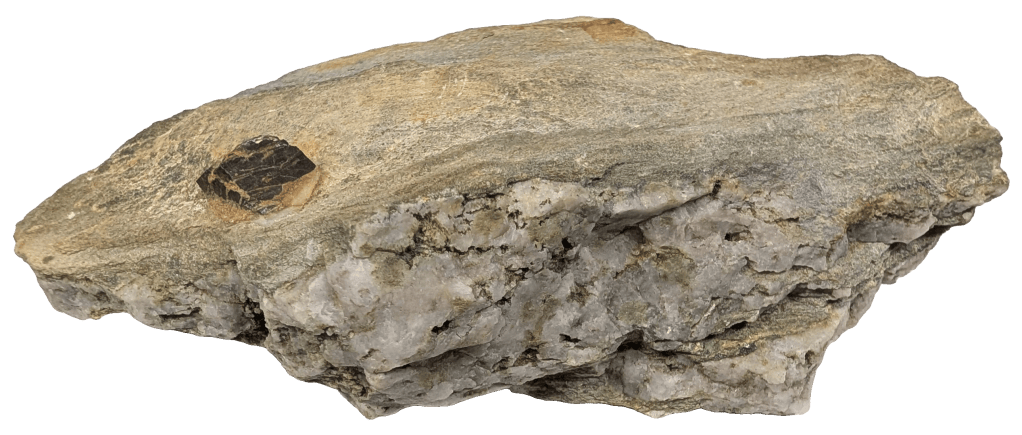
- A quartz vein running parallel to the foliation. Something new moved in, but it followed the existing grain of the rock instead of cutting across it.
- A big cube, about 1.5 cm across, called a porphyroblast. It’s a single crystal that grew much larger than the minerals around it. The foliation wraps around it, which tells me the crystal was already there, or growing, while the rock was being squeezed. Everything deformed around it, and it held its shape.
- The cube isn’t what it used to be. Chuck said it was either pyrite or magnetite. It’s a cube with striations on its faces, which is classic pyrite, and it isn’t magnetic. But it’s dark brown and rusty, not brassy gold. Over time, the pyrite was replaced by an iron oxide (maybe goethite) that kept the exact shape of the original crystal. That’s called a pseudomorph: same outward form, new material inside.
This hand sample packs a lot of punch for its size, so I requested it to add to my teaching collection.
That’s the shift I’ve been noticing since August. I’m still doing everything I did as a geologist: going on field trips, reading outcrops, squinting at hand samples, testing whether a cube is pyrite or magnetite. But now I do all of it through an educator’s lens. At the outcrop, I’m still asking what happened here. I’m also asking how I’d help a student see it.
The payoff is days like the ones I had that week. Even my class observation went well. My Dean told me that he’s always pleased with the level of enthusiasm that geologists bring to teaching, which I took as a compliment.
In Physical Geology lecture, we were working on mass wasting, the downhill movement of rock and soil (think landslides). During a demo with damp sand, I asked the students to make predictions, and Dawson started “talking” with his hands. He was shaping, in the air, what he predicted the sand would do before it moved. He was correct. That’s real geologic thinking: working forward from a process to the form it will make. And it’s exactly what I saw a field full of professional geologists doing that weekend, hands sweeping through the air as they described geologic structures and tectonic motion.
I also teach Historical Geology with a Lab. On our early lab Paleozoic day, Flavia and I were standing on either side of the stream table, looking at Paleozoic rock samples together. She connected the depositional environment, where and how the sediments were laid down, to the tectonic setting, what the plates were doing at the time. She did it by interpreting the sedimentary record. That’s working backward from the rocks to the story that made them, and I thought it was pretty great.
Forward and backward are the two directions geologists think in, and two of my students showed me both in the same week. Flavia’s reasoning is also exactly what I’m doing with my phyllite: reading its history from what’s preserved in it. Her samples told the story of the same ancient continental margin where my phyllite started out as mud.
I’m getting to know my students, and I thoroughly enjoy them.
Overprinted, not erased
So back to the rock on my desk.
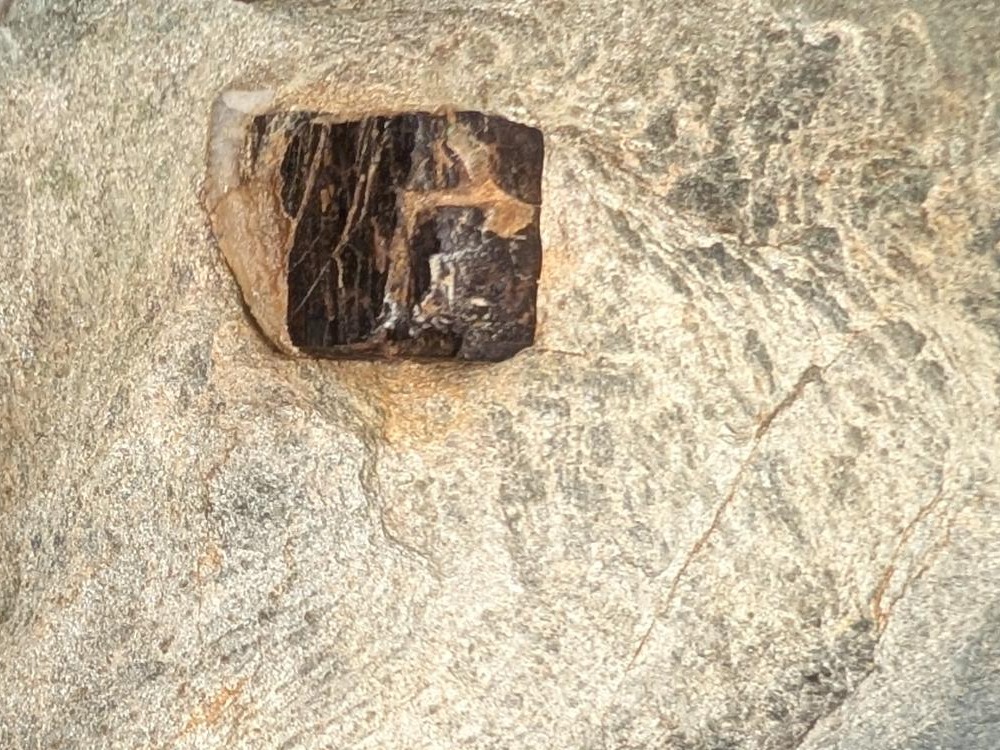
When I said I was mourning my research career, I think I was picturing something being erased. But that’s not how metamorphism works. The original rock doesn’t disappear. Under new conditions, it becomes something else, with minerals that couldn’t have grown before. The old fabric is still there, and you can still read it. A new one has grown over it.
That’s me right now. My geology training is the foliation: it set the grain of how I think, and it isn’t going anywhere. Teaching is growing along that grain, not cutting across it, like the quartz vein. And that pseudomorph has kept the shape of the original crystal but changed what it’s made of. I still look like a geologist and do geologist things. What fills them now is a little different.
It also seems fitting that this rock came from a transition zone. Geologists there have argued over whether it’s one sharp boundary, a single big fault, or a broad zone of gradual strain. My own transition has felt like the second one.
I’m not mourning my research career anymore. I’m excited about the work I’m doing, and about helping students learn to see the stories recorded in rocks.
I’ve ended up close to where I started: teaching geology in Northern Virginia, a little over ten years after a shiny, flattened rock on a trail near my apartment first caught my eye.
This time, I’m the one helping someone else see it.

