It’s been a while, y’all.
I’m writing this on a plane, heading back to a relatively new home in Northern Virginia. This summer I started a position as an Assistant Professor of Geology at Northern Virginia Community College in Annandale. Before that, I spent a year as a Visiting Professor at The College of Wooster in Ohio, teaching Earth Systems, Structural Geology, and Geographic Information Systems.
Since finishing my PhD, I’ve presented that research at several conferences, including this year’s General Assembly of the European Geosciences Union in Vienna, Austria. This trip was different: I didn’t present at all. I flew to Denver, Colorado, for the Geological Society of America’s annual meeting, GSA Connects, to celebrate the career of my PhD advisor and mentor, Kip Hodges.
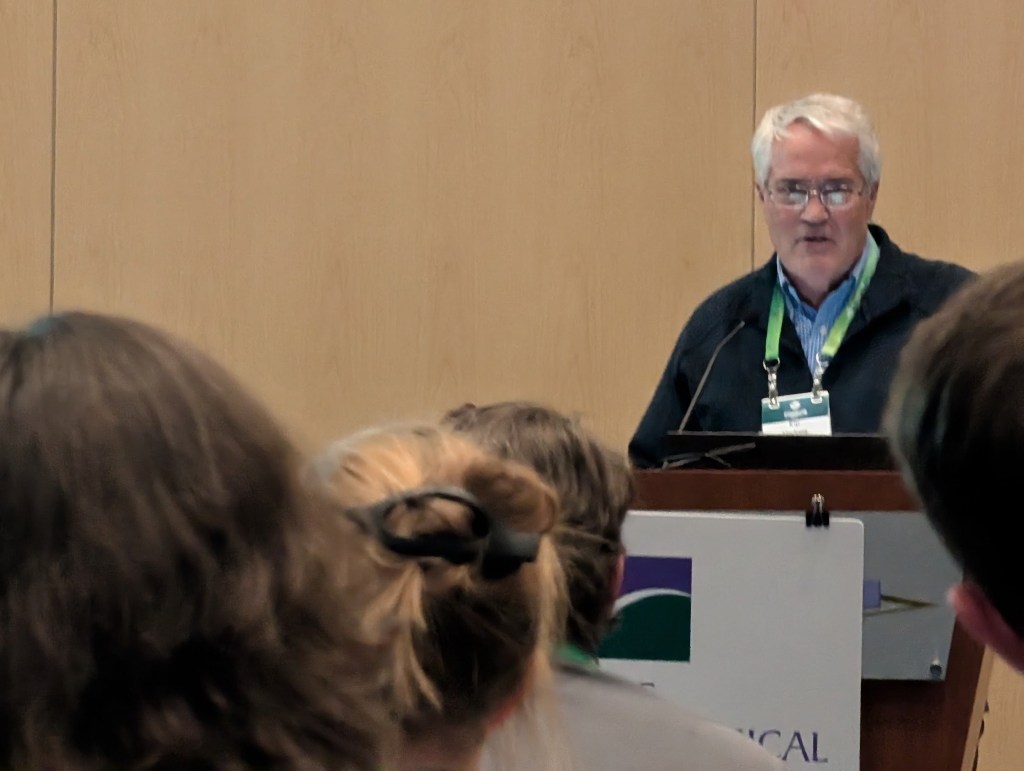
Kip has spent decades working in mountain belts all over the world and is best known for his field, analytical, and numerical work on Himalayan tectonics. That work is a big part of why I became a Himalayan geologist myself. This year, the Structural Geology & Tectonics Division of GSA honored him with its Career Contribution Award.
I remember when I first learned about the award. I looked up the list of past recipients and saw a roster of some of the most respected structural geologists and tectonicists in the field. My very next thought was, “Kip deserves this award.” So I recruited a friend who had also worked with Kip, and together we put together a nomination package. (Yes, I told him I was doing it.) His response was classic Kip: “I thought you had to be dead to receive that award.” The community’s support was tremendous. Kip earned the award (not surprisingly), and we got to celebrate his career together in Denver.
I served as lead advocate for the technical sessions held in his honor, From Minerals to Mountains: Interdisciplinary Investigations of Orogenic Systems. My co-advocates, Jackie Giblin, Kevin Furlong, and Ryan Thigpen, and I wanted the program to reflect how interdisciplinary Kip’s career has been. We invited two of his former advisees, Kate Huntington and Frances Cooper, to speak. Many others submitted their research as well, from Kip’s longtime colleagues to students just beginning their careers. The result was two oral sessions and a poster session that were well-attended and high-quality. With all of that in one place, it was impossible to miss how far Kip’s influence reaches.
After the sessions came the Division’s business meeting and awards ceremony. Kelin Whipple, Kip’s citationist, presented the Career Contribution Award, and then Kip gave his acceptance speech. Partway through, he talked about Clark Burchfiel, his own PhD advisor, who had received this same award years earlier. Kip showed a level of emotion I’ve rarely seen from him as he told us what Clark said when he got it: “I thought you had to be dead to get that.” That’s when I realized the line Kip gave me wasn’t his own. He’d been carrying Clark’s words all along. By the time he finished, the room was on its feet.
Relationships between mentors and their students can be complicated. There were moments, especially near the end of my PhD, when Kip’s approach didn’t feel like the easiest path. Looking back, I can see where it was leading. Kip helped me become a scientist, and now an educator, and I’m immensely grateful for that.
Sitting in that room, I kept thinking about how cyclical mentorship in science is. Clark shaped Kip, Kip shaped me, and pieces of each of them get passed down, sometimes as hard-won scientific insight and sometimes as a well-timed joke. We were celebrating the culmination of decades of Kip’s work while my own career is just getting started. After months of applications and virtual and campus interviews, I recently landed my first tenure-track job. It’s at NOVA, the same community college where I started as a first-generation student, and it focuses on teaching introductory geology.
Most of my students won’t become structural geologists. But some of them are sitting where I once sat, unsure whether science has room for them. If I can give them even part of what Kip gave me, I’ll consider that my own career contribution. And with any luck, someday one of them will nominate me for something, and I’ll know exactly what to say.
It’s good to be back, and I have plenty to write about. Coming up soon are a field trip along Corridor H, with its spectacular roadcuts through the Valley and Ridge, and the 2026 Virginia Geological Field Conference, focused on the Piedmont. It turns out the “province queen” is home for good, so stay tuned for more Virginia geology.

